Friday, March 1, 2019

Rosen: Remedial Income Tax 101 for Sen. Kamala Harris

Rosen: Remedial Income Tax 101 for Sen. Kamala Harris

There’s nothing new about politicians making unrealistic promises and preposterous claims while pandering to voters to win elections.  But it seems the degree of ridiculousness in these statements is reaching new lows these days.  This is especially true among the crop of radical progressives, although Donald Trump is not without fault in this area, himself.
Here’s a whopper from progressive Senator Kamala Harris (Democrat – California) who aspires to be president of the United States in 2021.  In a recent tweet Harris complained that, “The average tax refund is down about $170 compared to last year.”  She presented this fact as proof that the 2017 tax reforms enacted by Republicans in Congress and President Trump were really, in Harris’s words, “a middle-class tax hike to line the pockets of already wealthy corporations and the 1%.” The Washington Post fact-checker gave it “Four Pinocchios,” branding it “nonsensical and misleading.”
This kind of claim, standard left-wing class-warfare rhetoric, is flatly untrue.  The new $24,000 standard deduction for a married couple and the lower marginal tax rates all through the tax brackets indisputably reduced taxes for the great majority of lower-income and middle-class taxpayers.  Under the new law, in 2018 a family of four with two young children making as much as $59,000 in adjusted gross income (AGI) who take that $24,000 standard deduction and the increased child care credit of $2,000 per kid will have an income tax bill of exactly $0.  In 2017, under the old law, only families of four with less than $48,000 of AGI could zero out their tax bill.
The tax reforms were designed to simplify the tax code and broaden the base of taxable income, while taxing it at a lower rate.  Millions of lower- and middle-income filers will be dropped entirely from the tax rolls.  The estimated ten percent of tax filers who will still itemize deductions are mostly upper income taxpayers who will lose some deductions they’ve taken in the past.
Lowering our excessively high corporate income tax rates ─ well above the levels paid by our trading partners ─ has helped spur economic growth, capital formation, higher stock values, lower prices for consumers and increased pay for workers.  And the top one percent will continue to pay the lion’s share of the nation’s total individual income tax burden, carrying almost 40 percent of it all by themselves, while the bottom fifty percent pays only a three percent share.
Getting back to Harris’s tweet, the dumbest part of it was her complaint “that tax refunds are lower than in the prior year.”  That factoid is completely irrelevant.  Since some people are confused about terminology, let’s start with the basics.  A “tax return” isn’t the same as a tax refund.  Your tax return is simply the bundle of papers you send to the IRS that includes Form 1040 and all of the required schedules and other forms to go with it showing your income, deductions and taxes you’ve already paid, such as those withheld from your pay check.  It’s not a return of money.  That’s what your tax refund is, if you have money coming back.
If you do get a tax refund, that means you overpaid your taxes, which means you gave the IRS an interest-free loan instead of taking home more money in each paycheck during the course of the year.  Of course, if you overpay less, you get less of a refund.  But your total tax bill is exactly the same in any case.  Duh.
This isn’t high finance.  You needn’t be an economist or CPA to grasp this stuff.  Surely, Harris has looked at the tax returns she’s signed over the years, even if she’s had help filling them out.  As a United States senator who has to cast votes on tax policy she’s obliged to have at least a basic understanding of income taxes.  She must have some fiscal expert on her sizable senate staff who can tutor her.
Rookie Rep. Alexandria Ocasio-Cortez, the self-professed democratic socialist from New York and overexposed darling of the liberal media, frequently shoots from the hip with foolish remarks.  But she can be excused as an inexperienced youngster lacking knowledge in many areas apparently over her head.  Harris is presumed to be smart enough to know better.  She’s 44-years-old, a law school graduate, former San Francisco District Attorney and former California Attorney General.  But maybe I’m underestimating her intelligence.  Perhaps she does know better.  In which case she’s a liar and a demagogue.

O’Toole: Flawed analysis tries to rationalize transit’s decline

O’Toole: Flawed analysis tries to rationalize transit’s decline

Ride-hailing services are not the principle cause of transit ridership decline, according to a new report from TransitCenter, a New York-based transit cheerleading group. This is based on a survey of 1,700 people in seven different urban areas, including Denver.
Comparing the results with a similar survey from three years before, the group found a large increase in automobile ownership and that people who increased the number of trips they took by auto decreased the number of trips they took by transit. However, people surveyed who increased their use of ride-hailing services actually increased transit ridership, so TransitCenter concluded that increased auto ownership, not ride hailing, is the cause of transit’s problems.
A major problem with the study is that the people surveyed were not randomly selected — if they were, most of them wouldn’t have been transit riders. The amount of self-selection in the survey biases the results and says little about why the people who weren’t selected for the survey don’t ride transit — and their reasons may be completely different from those who were selected. Even if the survey was valid, TransitCenter admits that most of the factors reducing transit ridership are beyond the control of transit agencies. It recommends that transit agencies do the one thing that is within their control, which is to increase the “reliability and frequency” of transit service. While that may be important, in many urban areas–metro Denver included–it is time to question whether spending any more money on transit is actually worthwhile.
Indeed, the survey data itself fills less than a dozen pages of this 90-page report, suggesting that the survey was really an excuse to make headlines with a report advocating more transit subsidies. This raises the question of “who is TransitCenter?” This question isn’t really answered by the group’s web site.
According to Wikipedia, TransitCenter “was created by the [New York] area transit agencies working with local governments and the business community, and funded by the federal government…” in order to create a program to “sell” the idea of letting employers deduct transit passes that they buy for their employees from their taxes. (That doesn’t mean TransitCenter is primarily funded by the federal government, but it did get $250,000 from the Federal Transit Administration in 2017.)
TransitCenter spends between $5 million and $6 million a year, but has assets of nearly $82 million, nearly all of which are in Vanguard mutual funds. The group applied to be a 501(c)(3) (tax-deductible) organization, but failed to meet the IRS’s requirement that it be a “publicly supported” organization.
Instead, it is considered a “private foundation” that gives out grants to other transit advocacy groups. The group’s 2017 IRS report indicates that grant recipients included the Nashville Chamber of Commerce (which supported a $5 billion light-rail plan), Streetsblog, In Our Backyards (of Brooklyn), the Livable Streets Transportation Alliance, and various other “alternative transportation” groups. Other recipients include George Mason University, Massachusetts Institute of Technology, and Portland State University, effectively rewarding academics who support transit subsidies.
In all, about 50 groups received between $1,000 and $50,000, with the average group receiving about $27,000. The total value of these grants was about $1.5 million. In addition, TransitCenter spent $2.8 million on staff and professional fees, $495,000 on “travel, conferences, and meetings,” and $343,000 renting office space in the heart of New York’s financial district (and conveniently located near subway lines).
So basically TransitCenter is just another lobbying arm of the transit industry. Meanwhile, contradicting TransitCenter’s report, a paper by University of Kentucky researchers finds that the introduction of ride hailing into a city reduces rail ridership by 1.3 percent per year and bus ridership by 1.7 percent per year, an effect that “builds with each passing year.” While the exact numbers are just averages, the paper’s conclusion that ride hailing is “an important driver of recent ridership declines” seems more realistic to me.
Of course, this has contributed to efforts to demonize the ride-hailing industry. TransitCenter grant recipient Streetsblog has compiled a list of “all the bad things” about ride hailing, and most of them have to do with transit. Among the reasons are:
  • “They hurt transit.” Actually, any private business that that reduces the burden on a heavily taxpayer subsidized program should be considered a good thing.
  • “They reduce political support for transit.” Since transit is the most heavily subsidized form of travel in the United States, that’s also a good thing.
  • “They operate in transit-friendly areas.” People walk and bicycle in transit-friendly areas; shall we demonize them?
  • “They mostly replace biking, walking, or transit trips.” So what? I know some transit riders and cyclists hold a holier-than-thou view about their transport choices, but I don’t subscribe to it.
Streetsblog also claims that ride hailing increases traffic fatalities, citing a University of Chicago study. However, that study relies solely on a correlation-equals-causation argument: traffic fatalities began rising soon after ride-hailing companies were formed, so therefore ride hailing caused those fatalities. But the other thing that happened at about the same time as ride hailing was the increased use of the smart phones that enabled ride hailing, which increased distracted driving. I suspect distracted driving has had a much greater effect on traffic fatalities than ride hailing, which accounts for only a tiny percentage of total driving.
Public transit is not an end in itself; it is a means to an end or ends. If other forms of travel can provide that means without government subsidies, then we don’t need to defend transit against those other forms. Instead, we should celebrate the fact that we don’t need to keep subsidizing an obsolete transport technology that is slow, expensive, and inconvenient.

Give our votes to California via National Popular Vote?NO WAY!

Give our votes to California via National Popular Vote?NO WAY!

Give our votes to California via National Popular Vote?NO WAY!In an earlier post, I described some of the constitutional problems with the National Popular Vote Compact. (The plan is actually mislabeled, since  electoral votes would go to the plurality winner, even if the overwhelming majority of the popular vote was cast against him—something that happens regularly in countries that, like Mexico, choose presidents by pluralities.) In this Freedom Minute, I mention some of the other problems with the scheme.


California’s failed EV mandates; no one wants them

California’s failed EV mandates; no one wants them

California’s failed EV mandates; no one wants them
California’s electric vehicle mandates aren’t working admits Mary Nichols who heads up the powerful California Air Resources Board (CARB), according to a recent Reuters report.
“‘The strategies that we’ve used up until now just haven’t been effective,’ Mary Nichols, the head of the California Air Resources Board.”
The stunning confession comes as Colorado’s regulatory agencies draft rules mirroring California’s mandate on EVs that establishes quotas for auto manufacturers, which now appears to be a failure.
Californians now buy more than half of all EVs sold in the United States, and the state’s auto-pollution policies have provided a model being adopted around the world.
But they’re not working at home, by the state’s own measure. Tailpipe pollution here is going up, not down, despite billions of dollars spent by one of the most environmentally progressive governments on earth.
It’s unlikely to change. With only 284,000 EVs on the roads, California is a long way from its 1.5 million goal by 2025. Even with generous subsidies and rebates, consumers aren’t buying EVs.
The underlying problem, he [Association of Global Automakers President and CEO John Bozzella] argued, is that there is no purchasing mandate for consumers.
Maybe forcing auto purchasers to buy a car that they don’t want will be Governor Polis’s next executive order. It will give a new meaning to the term autocratic.

Denver’s sales tax measures: Too many, too much

Denver’s sales tax measures: Too many, too much 

Denver’s sales tax measures: Too many, too much

The good news for Denver voters is that there’s only one property tax measure on this fall’s ballot.
The bad news is that there are no fewer than four city sales tax increases.  While the goals of all of these proposals are noble, the price tag to city residents and shoppers is just too high, threatening to make an already costly city among the most expensive in the country.
The four proposed measures would raise sales taxes as follows:
  • Referred Measure 2A by 0.25 percent for parks construction and maintenance
  • Initiated Ordinance 300 by 0.08 percent for post-secondary scholarships for the next 12 years
  • Initiated Ordinance 301 by 0.25 percent for mental health, opioid/substance abuse, and subsidized housing
  • Initiated Ordinance 302 by 0.08 percent to promote “healthy meals and snacks” for children under 18
If all four measures were to pass, Denver’s sales tax would increase by 0.66 percent.  If the state were to pass the sales tax increase for transit and roads on top of that, the increase would be a whopping 1.28 percent.  Currently, Denver shoppers pay a sales tax of 7.65 percent.  That number would jump to 8.93 percent.  According to a 2017 Tax Foundation study, Denver’s sales tax burden currently ranks seventy-first among cities with 200,000 people or more.  We could vault to as high as number 16, passing New York City, San Francisco, and St. Louis.
Taken independently, the picture isn’t much prettier.
Since 2004, Denver’s population has averaged a 1.8 percent annual increase, while the national Consumer Price Index, a measure of inflation, has increased at a 2.0 percent annual rate.  In that same time, the city’s sales tax revenue has increased at a 4.3 percent annual rate, or roughly half a point faster than what it would take to keep pace with population plus inflation and maintain services.  This year, that amounts to a $47 million difference, or almost exactly the $46 million that the City Council wants to spend on parks.
Instead of asking the citizens of Denver to pay more, perhaps the taxpayers should be asking whether or not the government is already doing too much.
Initiative 300 proposes to raise $14 million in the first year for post-secondary scholarships, and to run for 12 years.  The idea is to build on the successful Denver Scholarship Foundation, which receives some government money, but is primarily funded through private contributions.  The new bureaucracy wouldn’t have to contend with fundraising, and would be limited to 5 percent administrative costs.
Nevertheless, sales taxes are inherently less stable than property taxes; in down years, with less money available for scholarships, staff would have to be cut.  Even a lean operation would still need some reserve in order to buffer the bad years, making it less efficient than its proponents advertise.
Initiative 302 would generate an estimated $14 million, but its mission is sufficiently vague so as to render it all but meaningless.  To be eligible, charities wouldn’t have to actually deliver meals to kids.  They could teach about gardening, for instance.  Denver’s current Healthy Meals program runs at about $270,000, most of which comes from a federal reimbursement program administered by the state. pumping about 50 times that amount into a group of ill-defined non-profits is a recipe for fraud and abuse.
Of all the proposed changes, the one we’re most sympathetic to is Initiative 301.  The opioid problem is real, and we’ve heard plenty about mental health in the last few years as well.  Whether or not the government is the most efficient avenue or the most sympathetic care provider is up for debate, but these problems take real, tangible tolls on our community.
That said, affordable housing has become something of a catch-all cause, and its advocates tend to ignore zoning regulations and building codes that deliberately increase density and drive up costs.  In such an environment, where the middle class can barely afford to own a home, those least-able to take care of themselves will naturally have it worse.
But perhaps the most unfair aspect of these proposals is that they rely on the sales tax.  One of the few things that both left- and right-leaning tax policy think tanks agree on is that sales taxes are regressive, and this remains true even in the face of exemptions for such items as food and clothing.
In effect, these measures ask the poor and working-class city residents to disproportionately fund government programs intended to help them.  So to get a post-high school education, or a home, or a better meal, the intended recipients first have to pay some bureaucrat’s salary, and then fill out a binder full of paperwork to prove they qualify.
Parks for our increasingly crowded city, meals for kids, college education, and help for the addicted and mentally ill are all good causes.  They are also better paid for by voluntary contributions, or by cutting less important spending, rather than by making life even more expensive for the poor and middle-class.

Sharf: Colorado cities slip in economic freedom

Sharf: Colorado cities slip in economic freedom

Colorado cities are among the most economically free – and therefore among the most competitive – in the country, but a new report from the Reason Foundation shows that freedom and prosperity is being eroded by a growing state government.
Using publicly available data, Dean Stansel, an economics research associate professor at Southern Methodist University (SMU), has rated the 52 Metropolitan Statistical Areas (MSAs) over 1 million in population, and the 330 MSAs with population under 1 million.  Denver rates 18th in the country in the first category, while 5 small Colorado MSAs rate in the top half of the second category, including four in the top third.
Click to enlarge
That’s the good news.  The bad news is that things have gotten worse for those Colorado MSAs between 2002 and 2012, the last year for which full data is available.
Stansel divided his research into three categories: Government Spending, Taxes, and Labor Freedom.  His calculations include state-level spending and taxation, in order to account for all local variations across the country.  He calculates individual scaled scores for each area, and then averages them together to get the overall score for an MSA.
The Colorado MSAs are Denver, Boulder, Pueblo, Greeley, Grand Junction, Colorado Springs, and Ft. Collins.  Averaged together, their overall scores were rising until 2002.
The effects on Colorado’s rankings have been predictable.  In 1997, Boulder was ranked the 8th-most economically free MSA in the United States.  In 2002, Denver cracked the top 10.  And that year, all six smaller MSAs were in the top 100, even traditional laggard Pueblo.
Not surprisingly, Colorado’s Taxation Score got a little bit of a boost after the passage of TABOR; not as much as you might think, although it has managed to hold onto it.
Click to enlarge
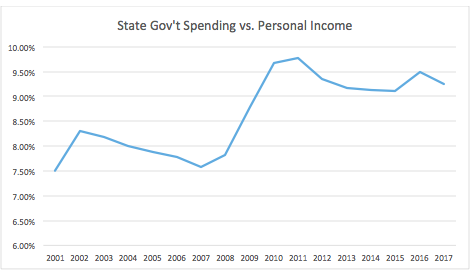
The biggest change concerns Government Spending as a Percentage of Per Capita Income, and most of the damage has been done at the state level.  On the whole, that score relative to the rest of the country was improving until 1997.  Then the post-9/11 recession and the Great Recession hit.  Not only did personal incomes decline, but state government spending per capita continued to increase.
Averaged over the seven Colorado MSAs, state government spending has come down slightly, but still remains well-elevated over its pre-Great Recession levels.
One might think that the same would be true of local government spending.  However, totaling the large- and medium-sized cities and the counties in the Denver-Aurora-Lakewood MSA, local government spending actually declined from 2009-2015.  Presumably, this is a result of TABOR restrictions, and the temporary unwillingness of cash-strapped citizens to approve tax increases.
The government spending that is hurting Colorado cities’ economic freedom and their associated prosperity is due almost entirely to the state.
Click to enlarge
Also significant has been the change in labor freedom.  Labor freedom increased from about 1972 until about 2002, as the economy shifted from heavily unionized industries such as mining and drilling to a more diverse and more service-oriented base.
Since then, however, the increasing size of government – usually, though not always, state government – has caught up with it.  The percentage of the work force engaged in state or local government determines the extent to which private enterprise has to compete for workers against the government.  The more people engaged in government work, the less free the labor market.
To some extent, this is an artifact of when the study ended.  Since Stansel was using the Census’s quinquennial survey of local governments, he had to end it in the last year for which there was data – 2012.  In that year, total employment in many localities was only slowly beginning to recover, even as state and local employment continued to rise or hold steady.
Click to enlarge
The Census has completed data collection for the 2017 edition, and the reports should be published sometime this year.  However, using data from the Bureau of Labor Statistics, we can see that since 2012, for most of the jurisdictions, the proportion has held steady or declined somewhat.  However, Boulder, Denver, and Colorado Springs MSAs have all seen increases in state government employment, helping to drive down both their scores and their rankings.
The lesson is clear for Colorado policymakers.  Despite their best efforts, Colorado localities are laboring under the burden of increased state spending.  That needs to be reined in, and local governments need to resist the temptation to engage in economically destructive behaviors like boosting the minimum wage.

Why We Are a Republic, Not a Democracy

Why We Are a Republic, Not a Democracy


Why We Are a Republic, Not a Democracy

Walter E. Williams | January 19, 2018 | 53,300
Why We Are a Republic, Not a Democracy
Hillary Clinton blamed the Electoral College for her stunning defeat in the 2016 presidential election in her latest memoirs, “What Happened.”
Some have claimed that the Electoral College is one of the most dangerous institutions in American politics.
Why? They say the Electoral College system, as opposed to a simple majority vote, distorts the one-person, one-vote principle of democracy because electoral votes are not distributed according to population.
To back up their claim, they point out that the Electoral College gives, for example, Wyoming citizens disproportionate weight in a presidential election.
Put another way, Wyoming, a state with a population of about 600,000, has one member in the House of Representatives and two members in the U.S. Senate, which gives the citizens of Wyoming three electoral votes, or one electoral vote per 200,000 people.
California, our most populous state, has more than 39 million people and 55 electoral votes, or approximately one vote per 715,000 people.
Comparatively, individuals in Wyoming have nearly four times the power in the Electoral College as Californians.
Many people whine that using the Electoral College instead of the popular vote and majority rule is undemocratic. I’d say that they are absolutely right. Not deciding who will be the president by majority rule is not democracy.
But the Founding Fathers went to great lengths to ensure that we were a republic and not a democracy. In fact, the word democracy does not appear in the Declaration of Independence, the Constitution, or any other of our founding documents.
How about a few quotations expressed by the Founders about democracy?
In Federalist Paper No. 10, James Madison wanted to prevent rule by majority faction, saying, “Measures are too often decided, not according to the rules of justice and the rights of the minor party, but by the superior force of an interested and overbearing majority.”
John Adams warned in a letter, “Remember democracy never lasts long. It soon wastes, exhausts, and murders itself. There never was a democracy yet, that did not commit suicide.”
Edmund Randolph said, “That in tracing these evils to their origin, every man had found it in the turbulence and follies of democracy.”
Then-Chief Justice John Marshall observed, “Between a balanced republic and a democracy, the difference is like that between order and chaos.”
The Founders expressed contempt for the tyranny of majority rule, and throughout our Constitution, they placed impediments to that tyranny. Two houses of Congress pose one obstacle to majority rule. That is, 51 senators can block the wishes of 435 representatives and 49 senators.
The president can veto the wishes of 535 members of Congress. It takes two-thirds of both houses of Congress to override a presidential veto.
To change the Constitution requires not a majority but a two-thirds vote of both houses, and if an amendment is approved, it requires ratification by three-fourths of state legislatures.
Finally, the Electoral College is yet another measure that thwarts majority rule. It makes sure that the highly populated states—today, mainly 12 on the east and west coasts, cannot run roughshod over the rest of the nation. That forces a presidential candidate to take into consideration the wishes of the other 38 states.
Those Americans obsessed with rule by popular majorities might want to get rid of the Senate, where states, regardless of population, have two senators.
Should we change representation in the House of Representatives to a system of proportional representation and eliminate the guarantee that each state gets at least one representative?
Currently, seven states with populations of 1 million or fewer have one representative, thus giving them disproportionate influence in Congress.
While we’re at it, should we make all congressional acts by majority rule? When we’re finished with establishing majority rule in Congress, should we then move to change our court system, which requires unanimity in jury decisions, to a simple majority rule?
My question is: Is it ignorance of or contempt for our Constitution that fuels the movement to abolish the Electoral College?