Thursday, June 4, 2020

New Cases In The Last Three Weeks

Data as of 5:33 a.m. on June 4, 2020. Daily heatmap as of 11:59 p.m. ET, June 3.

State
Cases
Deaths
United States
1,851,368
107,172
New York
374,085
30,019
New Jersey
162,068
11,880
Illinois
123,830
5,621
California
119,348
4,374
Massachusetts
101,592
7,152
Pennsylvania
77,780
5,742
Texas
68,877
1,744
Florida
58,764
2,566
Michigan
58,035
5,570
Maryland
54,982
2,641
Georgia
48,894
2,123
Virginia
46,905
1,428
Connecticut
43,091
3,989
Louisiana
41,133
2,870
Ohio
36,792
2,300
Indiana
35,712
2,207
North Carolina
31,276
999
Colorado
27,046
1,494
Minnesota
25,870
1,097
Tennessee
24,833
388
Washington
22,484
1,135
Arizona
22,356
983
Iowa
20,300
574
Wisconsin
19,400
616
Alabama
18,851
653
Mississippi
16,322
782
Rhode Island
15,219
742
Nebraska
14,885
170
Missouri
14,189
791
South Carolina
12,415
501
Utah
10,497
117
Kentucky
10,410
450
Kansas
10,092
226
Delaware
9,712
375
District of Columbia
9,016
473
Nevada
8,951
431
New Mexico
8,140
375
Arkansas
8,067
142
Oklahoma
6,805
341
South Dakota
5,162
62
New Hampshire
4,795
265
Oregon
4,399
159
Puerto Rico
4,023
140
Idaho
2,933
83
North Dakota
2,679
66
Maine
2,418
95
West Virginia
2,077
78
Vermont
990
55
Wyoming
915
17
Hawaii
653
17
Montana
525
17
Alaska
504
10
Guam
177
5
Virgin Islands
70
6
Northern Marianas
24
16
American Samoa
0
0

Wednesday, June 3, 2020

America's New State-Run Church

America's New State-Run Church

For what seems an eternity, one of the ongoing accusations leveled by secularists against Christians and the Church was that Christians kept their heads in the clouds.  Believers have been told they have been too heavenly minded to be any earthly good, that they needed to be where the action really was, directing their energies to down-to-earth, pragmatic deeds.
So it is with some astonishment that the faithful see Governor John Carney of Delaware, along with other state governors such as California's Gavin Newsom,  order church leaders and congregants to keep their nonessential heads in the tech cloud.  Carney's recommendation?  "Do your best to practice your faith virtually."
No matter how virtuous or sentimental their motives, the almost complete capitulation of priests and pastors to banishment by government leaders like Carney has been astonishing.  Few have meaningfully protested the exile of the Church into the cloud.  In fact, nearly all churches voluntarily have closed their sanctuaries and ascended into cyberspace.
The nearly universal retreat into the cloud meant that the Church accepted social distancing more severe than the six feet enforced by grocery stores.  It meant church leaders distanced themselves from their congregations altogether, consigning their flocks to a cyber-environment that is COVID-19 free but certainly not free from the virus of political correctness enforced the church of Big Tech minders.
Basically, the Church acceded to a definition of itself as non-essential, thus relegating itself to the status of any other business or institution.  By beating a retreat into the cloud, the Church shrank itself into the tech matrix, subjecting itself to the arbitrary touch of a fingertip or click of a mouse, becoming just another one of the gods inhabiting the cloud above Mt. Tech Olympus.
But what is just as important as the ascension of the Church into the cloud is the fact that state governments, now fortified by SCOTUS, will expect churches to continue to follow severe restrictions set up during and after the total shutdown.  Churches will be expected to follow regulatory requirements for reopening that amount to the equivalent of a "fundamental transformation" of the churches.  
Government leaders, now heartened by the swing decision of Chief Justice John Roberts,  will continue to commandeer the way church is done by altering the liturgy, the habits, and the ways and means of worship as surely as if an altar devoted to Zeus were placed in the sanctuaries and congregants were forced to bow down and offer incense to the god.  
Delaware is but one example of the establishment of the new state churches. As of May 18, Delaware's governor issued his state church initiatives, including the new liturgical practices conforming to COVID correctness:   

  • Attendance is limited to a maximum of 30% of occupancy.
  • Social distancing of 6 feet or more is required (except for
    members of the same household).
  • The length of the service can be no longer than one hour.
  • Individuals age 13 and up are required to wear a cloth
    face covering.
  • Services are limited to one day per week.
  • Gathering times must be staggered to permit cleaning
    before the next service.
  • Churches are asked to establish a system for staggering
    the arrival of worshippers.
  • Older citizens are advised not to attend at all.
When have we seen similar draconian restrictions on the Church?  It may help to review the Bolsheviks' responses to the Orthodox church that formed Russia's spiritual life from 988 A.D. on.  
Robert Conquest, the author of Harvest of Sorrow, relates that Lenin's letter of November, 1913 to Maxim Gorky stated the party position quite flatly:
Every religious idea, every idea of God, is unutterable vileness ... of the most dangerous kind, contagion of the most abominable kind.  Millions of sins, filthy deeds, acts of violence and physical contagions ... are far less dangerous than the subtle, spiritual idea of God decked out in the smartest ideological costumes.  Every defense or justification of God, even the most refined, the best intentioned, is a justification of reaction.
In other words, the Russian Orthodox Church itself was considered a pathogen within society.  Churches were regarded as ideologically germ-ridden places to be sanitized by correct thinking.
Lenin went on to say it was best to start the eradication of the church by giving "an impression of toleration with control, humiliation of the churches rather than with overt suppression." (Italics mine.)
In sum, church activity was to be reduced to the performance of services alone.  Russians were to practice their faith by ritual only, much as governor Carney advises when he suggests Christians should learn to practice their faith "virtually."
The exile of the churches into virtual reality provides an opportunity for some self-examination.
Perhaps the COVID-19 crisis will encourage church leaders to think about how and what happens when sanctuaries are vacated and seven devils loosed by the State enter as the shutdown is somewhat lifted.
They might wish to reflect about what to do when the State wishes to cleanse the church of "diseased" doctrines — to think about what to do when the Church's beliefs are declared hate speech pathogens.
Just as importantly, leaders also might think about how the flock has been deprived of community and thus of corporate worship and corporate prayer.  They may wish to meditate on the sacramental aspect of the community of the saints.
For many if not most churches, the celebration of Holy Communion is when the body and blood of Christ are offered as essential spiritual food pastors and priests are required to dispense.  But the shepherds of the flock almost universally have quit offering spiritual wine and bread, leaving their sheep to fend for themselves.   
In short, within a space of weeks, Americans have seen the entirety of American Christendom shut down and the overnight ascension of what is essentially a secularist state church.  The initially nascent state church has now been more firmly established by SCOTUS's decision to allow state control of churches for reasons of "health." 
When any government even temporarily takes over the churches for any reason, it has essentially shattered the autonomy of the Church, making it subservient to the State.  The Church under orders from the State is then subject to forcible conformance to State dogma.
The state that dictates when and where and how and to whom the sacrament of the Lord's Supper is administered is the state that has taken over the church and substituted its own sacraments.  The state that dictates the how, when, and where of the baptism of children is the state that has created its own church.  The state that decides when, where, and how many of the faithful can listen to the preaching of the Word or how many can assemble to pray together is the state that also dictates what is to be preached and prayed.  The state that insists that worshipers wear and sing through face masks is the state that determines the way virtues of the state churches are signified.  The state that ranks the Church of God to be an institution equal to bars, restaurants, and public schools is the state that will disregard the unique status of the Church and its constitutional rights.
As the directives from the state begin to strangle the Church, the latter is faced with a choice it probably should have made at the beginning of the state takeover.  Pastors and priests must make the decision to open their churches to worship services and to continue the churches' ministries as they were before the coronavirus coup.  They must remember what the Church is and obey God rather than the State.
For if they do not, it's predictable that the almighty State will squeeze the churches harder, requiring total conformity to the State that certainly seems ready to hijack the Church's mission, to vitiate its standing in constitutional law, to appropriate its wealth, and to take over its institutions by force if necessary.
It's time for all believers, leaders and congregants alike, to remember the words of St. Ambrose: "Not only for every idle word must man give an account, but for every idle silence."

Limbaugh: Rioters 'are paid, and they are laying in wait'

Limbaugh: Rioters 'are paid, and they are laying in wait'

'None of this is random. It is organized, it is programmed'


Rush Limbaugh (Video screenshot courtesy RushLimbaugh.com)
The riots that have rocked cities across America in the wake of the police-related death of George Floyd are planned and paid for in advance, and can be linked to the Democratic Party, says talk-radio star Rush Limbaugh.
"None of this is random," Limbaugh said Tuesday on his national broadcast.
"None of this is something [that just] happens and these people see it and they get mad and take to the streets. They are waiting. They are programmed. They are waiting for the call to action. It's not that George Floyd was murdered; it's that somebody was at the hands of a cop, and that's the go signal.
"They are paid, and they are laying in wait. They're in homes, wherever they are, wherever they're holed up, and they're given the go signal, and this stuff is then, with the aid of the media, it's made to look spontaneous. That's key. It's made to look like these people were happy and fine and minding their own business until America became America again one day, when in fact this stuff is in the playbook, it is organized, it is programmed, it is paid for, and it's very mobile."
As the U.S. has said it's looking to designate Antifa, the group believed by many to be responsible for the protests and riots, as domestic terrorists, Limbaugh explained the so-called "anti-fascists" fomenting the violence are radical leftists who have been known by various names in recent years.
"Antifa is simply a new name for all of these left-wing, Democrat Party-aligned and sponsored protest groups going back to the sixties," he said.
"You had the Weathermen ... the SDS, Students for Democrat Society. I can't even think of all the names. Antifa is Occupy Wall Street. It's Black Lives Matter. They're all the same people and thinking under different names. They have different organizations for the purposes of fundraising.
"Membership is actively recruited. But it is the Democrat Party. They are the Democrat Party. What you see on the streets of New York and all these other blue states, this is – what's the term, the outgrowth? This is what you get. This is the Democrat Party. This is what they sponsor. This is what they inspire. This is what their policies lead to. Democrat Party policies are conceived and created in rage and anger."
Limbaugh admitted he got a couple of emails from readers asking if he wanted to "walk back" his assertion that the riots were tied to the Democratic Party.
"I don't want to walk that back," he stressed. "Is there or is there not a political party that sees political advantage in riots, looting, and arson? There is. Is there or is there not a political party that sees political opportunity in 40 million Americans out of work? Yes! It's not even arguable.
"Is there or is there not a political party that implemented policies that ended up killing tens of thousands of elderly people in nursing homes? Yes! Yes! It's the Democrat Party. It's in New York. It's in the State of Washington.
"Is there or is there not a political party which continues to seek a benefit from an economic shutdown in a number of blue states? Yes! The answer to every question I've asked is 'yes,' and the particular party we're talking about is the Democrat Party. Is there or is there not a political party that used America's law enforcement and intelligence agencies to spy on and attempt to overturn the election of Donald Trump? Yes! It's inarguable. There is so much going on now that it is easy to get lost in what's on television and what's all over social media.
"But if you try, if you step back, you will see what is critical in this country: You must reject the Democrat Party. The Democrat Party is the reason for the angst; the reason for the nervousness, the fear, the anger, trepidation. All of this can be traced to the Democrat Party and a famously uttered philosophy of theirs: A crisis is a terrible thing to waste."
As WND reported Monday, police in Kansas City said officers found bricks and rocks staged near protest sites around the city, stoking concerns that individuals or groups had pre-planned looting and destruction that hit the city over the weekend.

Tuesday, June 2, 2020

The History Behind 'When The Looting Starts, The Shooting Starts'

The History Behind 'When The Looting Starts, The Shooting Starts'

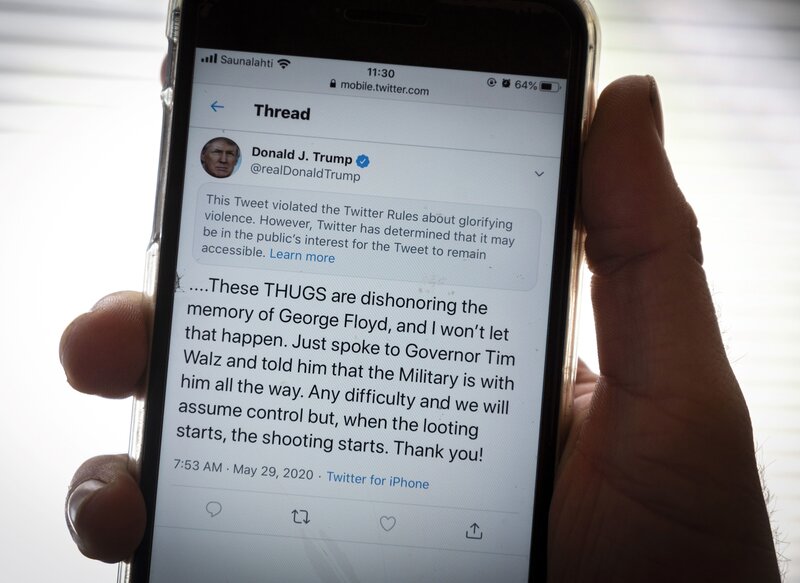
President Trump's Twitter page is displayed on a mobile phone. The social media company flagged one of his tweets about Minneapolis as "glorifying violence" and hid it from public view unless a user clicks on it.

Updated: 6:45 p.m. ET
President Trump told reporters Friday evening that he didn't know the racially charged history behind the phrase "when the looting starts, the shooting starts." Trump tweeted the phrase Friday morning in reference to the clashes between protesters and police in Minneapolis following George Floyd's death. It dates back to the civil rights era and is known to have been invoked by a white police chief cracking down on protests and a segregationist politician.
Twitter took an unprecedented step in limiting the public's ability to view the president's tweet threatening shooting, saying it "violated the Twitter Rules about glorifying violence." The tweet is hidden unless a user clicks to display it, and users cannot like or reply to it.
In 1967, Miami police Chief Walter Headley used the phrase "when the looting starts, the shooting starts" during hearings about crime in the Florida city, invoking angry reactions from civil rights leaders, according to a news report at the time.
Article continues after sponsor message
"He had a long history of bigotry against the black community," said professor Clarence Lusane of Howard University.
"The NAACP and other black organizations had for years complained about the treatment of the black community by Miami police. At this hearing, in discussing how he would deal with what he called crime and thugs and threats by young black people, he issued this statement that the reason Miami had not had any riots up to that point, was because of the message he had sent out that 'when the looting starts, the shooting starts,' " Lusane said.
Headley was head of the police force for 20 years and referred to his "get tough" policy on crime during a 1967 news conference as a war on "young hoodlums, from 15 to 21, who have taken advantage of the civil rights campaign. ... We don't mind being accused of police brutality."
According to Lusane, Headley may have borrowed the phrase from Eugene "Bull" Connor, who had been the notorious public safety commissioner in Birmingham, Ala. Connor was a segregationist who directed the use of police dogs and fire hoses against black demonstrators.
Miami police Chief Walter Headley, left, watches as the Rev. Theodore Gibson tells the Miami City Commission he believed Headley had used overly strong language in announcing his war on crime in December 1967.
Jim Bourdier/AP
The late 1960s saw major riots and uprisings in cities such as Detroit in response to police action against the black community.
Headley's use of the phrase is thought to have contributed to intensified race riots, including one of the most serious ones in Miami in 1980, when a black man, Arthur McDuffie, was beaten into a coma by up to a dozen white Dade County police officers after he ran a red light on his motorcycle. He later died from his injuries.
Segregationist presidential candidate George Wallace also used the phrase during the 1968 campaign.
Trump sought to clarify his comments Friday afternoon again on Twitter: "Looting leads to shooting, and that's why a man was shot and killed in Minneapolis on Wednesday night - or look at what just happened in Louisville with 7 people shot. I don't want this to happen, and that's what the expression put out last night means. It was spoken as a fact, not as a statement. It's very simple, nobody should have any problem with this other than the haters, and those looking to cause trouble on social media. Honor the memory of George Floyd!"
The president took questions from the press Friday evening following a meeting with business leaders to discuss reopening the economy. When asked about his use of the phrase, Trump said he was unfamiliar with its history.
"I've heard that phrase for a long time. I don't know where it came from or where it originated," Trump said. "Frankly, it means when there's looting, people get shot and they die. And if you look at what happened last night and the night before, you see that, it's very common. And that's the way that's meant."
Trump said he had spoken with family members of Floyd.
"He was in tremendous pain, obviously, and couldn't breathe. It was very obvious to anybody that watched it," Trump said.
"It was a very, very sad thing for me to see that. We also know that most policemen, you see the great job they do; they do a fantastic job. But this was a terrible insult to police and to policemen," the president said.
Trump had tweeted earlier this week that the FBI and Department of Justice are "well into an investigation as to the very sad and tragic death in Minnesota of George Floyd." The president said he asked for the investigation to be expedited.
Regardless of Trump's intended meaning in his comments about "looting" and "shooting," Lusane said the message is not one of reconciliation and healing.
"So often Trump has engaged in dog whistles," Lusane said. "But he also engages in blaring trumpets. And this is a pretty clear and very loud message that the response should not be let's try to address the justice issues that are involved here but let's be hard-line."

F.D.R. Warned Us About Public Sector Unions

F.D.R. Warned Us About Public Sector Unions

James Sherk
James Sherk is the Bradley fellow in labor policy at the Center for Data Analysis at the Heritage Foundation.

Updated July 23, 2014, 4:19 PM

“It is impossible to bargain collectively with the government.”

That wasn’t Newt Gingrich, or Ron Paul, or Ronald Reagan talking. That was George Meany -- the former president of the A.F.L.-C.I.O -- in 1955. Government unions are unremarkable today, but the labor movement once thought the idea absurd.
Public sector unions insist on laws that serve their interests -- at the expense of the common good.
The founders of the labor movement viewed unions as a vehicle to get workers more of the profits they help create. Government workers, however, don’t generate profits. They merely negotiate for more tax money. When government unions strike, they strike against taxpayers. F.D.R. considered this “unthinkable and intolerable.”
Government collective bargaining means voters do not have the final say on public policy. Instead their elected representatives must negotiate spending and policy decisions with unions. That is not exactly democratic – a fact that unions once recognized.
George Meany was not alone. Up through the 1950s, unions widely agreed that collective bargaining had no place in government. But starting with Wisconsin in 1959, states began to allow collective bargaining in government. The influx of dues and members quickly changed the union movement’s tune, and collective bargaining in government is now widespread. As a result unions can now insist on laws that serve their interests – at the expense of the common good.
Union contracts make it next to impossible to reward excellent teachers or fire failing ones. Union contracts give government employees gold-plated benefits – at the cost of higher taxes and less spending on other priorities. The alternative to Walker's budget was kicking 200,000 children off Medicaid.
Governor Walker’s plan reasserts voter control over government policy. Voters’ elected representatives should decide how the government spends their taxes. More states should heed the A.F.L.-C.I.O. Executive Council’s 1959 advice: “In terms of accepted collective bargaining procedures, government workers have no right beyond the authority to petition Congress — a right available to every citizen.”

Monday, June 1, 2020

Wildlife agency testing shows wolves migrating into Colorado carry dangerous parasite

Wildlife agency testing shows wolves migrating into Colorado carry dangerous parasite


Wildlife agency testing shows wolves migrating into Colorado carry dangerous parasite

DENVER–In mid-February the Colorado Division of Parks and Wildlife (CDPW) reported the presence of a pack of six wolves in northwestern Colorado. Genetic testing on feces samples found near a scavenged elk carcass in Moffat County confirmed that at least three females and one male wolf are living in Colorado.
The feces testing also confirmed that three of the six fecal samples are carrying the potentially-deadly hyatid disease.
Colorado has been anticipating the natural migration of wolves into the state since at least May, 2005, when CDPW’s Wolf Management Working Group’s 2004 recommendations were adopted by the Colorado Parks and Wildlife Commission.  The Commission is a citizen board, appointed by the governor, which sets regulations and policies for the wildlife agency.
The plan goals include “acceptance of a wolf presence in Colorado” contingent on being able to deal with potential or actual conflicts with humans, livestock, big game and habitat impacts as well as close management and monitoring of wolves and livestock depredation and both compensation and deterrence funding for ranchers.
Now a new threat to wildlife, livestock and even humans has emerged.
Hyatid disease, or Echinococcus granulosus is a parasitic tapeworm found in canids such as dogs, wolves, coyotes and foxes. This parasite requires two hosts during its lifecycle. The tapeworms, about 3-5 mm long, live in the small intestines of canids and the eggs are passed in feces. The eggs are tiny and quite hardy, remaining viable for up to a year.
The intermediate hosts are ungulates, which includes elk, deer, moose, sheep and cattle. These hosts pick up the eggs while browsing in areas where host feces are found.
Infections cause wasting, loss of weight and other health issues in host animals, including livestock. The cycle completes when predators and scavengers eat the viscera of infected animals.
Domestic animals including cattle, sheep, dogs and cats can be infected, and can pass the infected eggs to humans.
While humans are not a natural host they can be infected by ingesting the parasite’s eggs. Usually this happens after handling contaminated soil, canid feces or fur, through breathing infected dust stirred up by human activity and ingestion of contaminated foods such as green vegetables and berries.  Deaths from the disease have not been well documented, but according to one 2012 research paper, there have been at least 41 deaths in the U.S. between 1990 and 2007
Research on wolves in Idaho and Montana by a team lead by Washington State University College of Veterinary Medicine researcher Willian J Foreyt between 2006 and 2008 revealed that 62% of wolves in Idaho and 63% of wolves in Montana were infected with the tapeworm.
A 2018 research study out of Colorado State University in Fort Collins, published in the Center for Disease Control’s Emerging Infection Diseases Journal says, “Although well studied globally, the current presence, prevalence, and transmission dynamics of Echinococcus spp. tapeworms in the contiguous United States are currently unknown. Substantial research was conducted between the early 1930s and the 1980s; however, very little research has occurred in the past 3 decades…Canada appears to be experiencing an increase in the presence and prevalence of E. multilocularis tapeworms, with spillover events starting to occur. If this asserted expansion is true, a similar expansion may be occurring in the United States.”
Thirty eight of Colorado’s 64 counties have passed formal resolutions opposing the forced introduction of Canadian grey wolves proposed by Lake George resident and CEO of the Colorado Wolf and Wildlife Center Darlene Kobobel and Gail Bell of Aurora.
Kobobel and Bell gathered the required signatures and the initiative has been placed on Colorado’s November 2020 state-wide ballot as a statutory measure.
But wolves aren’t waiting for an election, they are already here.

More Reasons to Flee Blue States

More Reasons to Flee Blue States

More Reasons to Flee Blue States

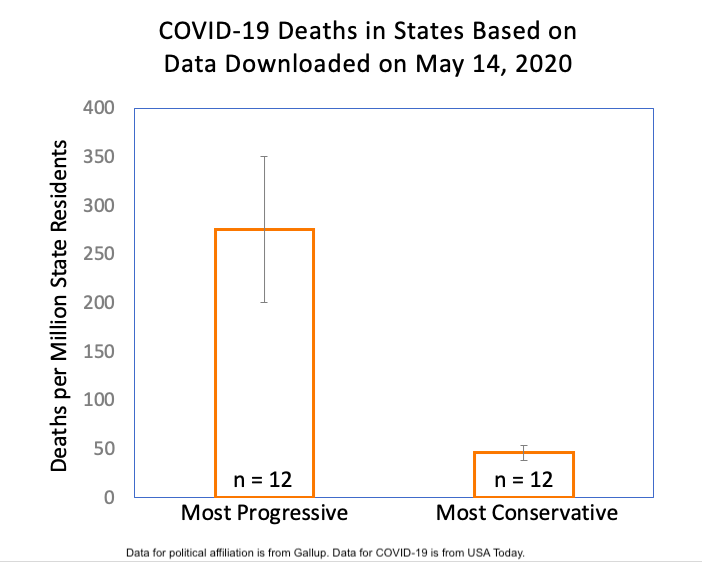
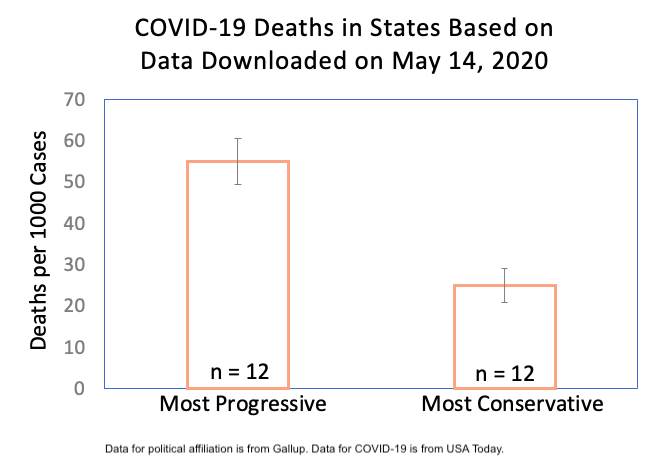
For years Americans have been relocating from blue states to red states in search of jobs and affordable housing. The heavy-handed lockdown policies of governors in some blue states will no doubt accelerate this trend. Adding insult to injury is the disproportionately high death rate of COVID-19 patients in some of these states (See Graphs 1, and 2 below, and Table 1 below).
In all fairness, many blue states are more urbanized and population density plays a major role in spreading the virus, but this fails to explain why people already infected with coronavirus are dying at a higher rate in many of these states (Graph 2). It also fails to explain how some highly urbanized states like Utah and Florida manage to keep their death rates so much lower than death rates in comparably urbanized states like New York and Connecticut (Tables 2 and 3).
When states are sorted in order of deaths per 1,000 cases, an important pattern becomes evident (Table 3): Nursing homes in five of the seven worst affected states were ordered or paid to take in recovering COVID-19 patients. Massachusetts rescinded this requirement after objections from the medical community, but New York, New Jersey, Pennsylvania, and Michigan doubled down and turned their nursing homes into slaughterhouses for the elderly.
Instead of owning up to this mistake, the state of New York is trying to minimize the evidence by excluding nursing home residents who died in hospitals from their tally of nursing home deaths.
Another pattern evident in Table 2 is that nearly all states with more than 60 deaths per 1,000 cases scored low on fiscal health in 2018. Four of them (Connecticut, Massachusetts, New Jersey, and New York) ranked among the 10 worst in this parameter (Table 3). These four state were also ranked by another source among the 10 worst for infrastructure.
Connecticut and Massachusetts did not force nursing homes to accept COVID-19 patients, but lack of state funding may have compromised their ability to protect nursing homes. Louisiana’s fiscal health is not as poor as that of these two states, but 30% of its population is African-American and for various reasons people in this group are dying from COVID-19 at double the overall rate.
In sharp contrast to the nearly bankrupt states of New York and New Jersey, Florida focused its resources on protection of nursing homes with frequent testing and isolation of anyone testing positive. Consequently, even though Florida ranks first in percent of residents over 65, it currently ranks 25 out of 50 for death rate. Florida is also among the few states currently open despite blistering criticism from the media. The sunshine state already ranks fourth best in the nation for fiscal health. Re-opening for business (with necessary precautions) will no doubt keep Florida in a better position to continue providing resources for the elderly.
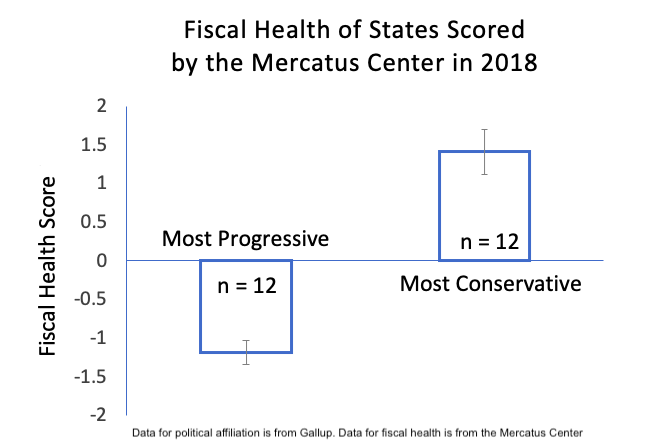
Budgetary mismanagement goes hand-in-hand with progressivism (Graph 3). This is why President Trump raised concerns about sending more federal aid to these states. Unsurprisingly, governors reluctant to open their states complain that this will undermine their ability to provide social services to the less fortunate.
William Simon, who served as Treasury secretary under President Ford got the same treatment from the media after he refused to bail out New York City. Simon called out their lack of self-awareness by pointing out that New York’s deficit spending was responsible for “the cruelest tax of all -inflation, under the guise of being compassionate.” Indeed. If these worst-affected states are cash-strapped because of their “compassion”, why were they losing so many residents as far back as 2016?
The blue state model has never been about empowering the most vulnerable. It has always been about empowering the ruling class by means of grievance-driven constituencies, utopian fantasies, bloated bureaucracies, and deficit spending. The procrustean lockdown policies of governors in most blue states puts on full display their dismissive attitude towards blue-collar jobs. Too bad it took a world pandemic and the near total destruction of the small business community to expose this mockery of America’s founding principles.

Table Credits: Data for political affiliation for 20152016, and 2017 is from Gallup. Fiscal health scores comes from the Mercatus Center. Coronavirus data (accessed on May 14, 2020) is from USA Today.
Table 1: Data sorted in order of political affiliation. The 12 most progressive states are highlighted in blue. The 12 most conservative states are highlighted in red.
Table 2: Data sorted in order of deaths per million state inhabitants. The 12 most progressive states are highlighted in blue. The 12 most conservative states are highlighted in red.
Table 3: Data sorted in order of deaths per 1000 cases of coronavirus. The 12 most progressive states are highlighted in blue. The 12 most conservative states are highlighted in red.
Table 4: Data sorted in order of fiscal health. The 12 most progressive states are highlighted in blue. The 12 most conservative states are highlighted in red.
Graph 1: Mean death rates per million state inhabitants in most progressive and conservative states. Based on a T-test, the difference is significant at p = 0.005. Error bars represent standard error.
Graph 2: Mean death rates per thousand cases of coronavirus in most progressive and conservative states. Based on a T-test, the difference is significant at p = 0.0001. Error bars represent standard error.
Graph 3: Mean fiscal health scores in most progressive and conservative states. Based on a T-test, the difference is significant at p = 0.00001. Error bars represent standard error.