Sunday, February 26, 2012

United States' economy: Over-regulated America | The Economist

United States' economy: Over-regulated America | The Economist

Over-regulated America

The home of laissez-faire is being suffocated by excessive and badly written regulation

AMERICANS love to laugh at ridiculous regulations. A Florida law requires vending-machine labels to urge the public to file a report if the label is not there. The Federal Railroad Administration insists that all trains must be painted with an “F” at the front, so you can tell which end is which. Bureaucratic busybodies in Bethesda, Maryland, have shut down children’s lemonade stands because the enterprising young moppets did not have trading licences. The list goes hilariously on.

But red tape in America is no laughing matter. The problem is not the rules that are self-evidently absurd. It is the ones that sound reasonable on their own but impose a huge burden collectively. America is meant to be the home of laissez-faire. Unlike Europeans, whose lives have long been circumscribed by meddling governments and diktats from Brussels, Americans are supposed to be free to choose, for better or for worse. Yet for some time America has been straying from this ideal.

Consider the Dodd-Frank law of 2010. Its aim was noble: to prevent another financial crisis. Its strategy was sensible, too: improve transparency, stop banks from taking excessive risks, prevent abusive financial practices and end “too big to fail” by authorising regulators to seize any big, tottering financial firm and wind it down. This newspaper supported these goals at the time, and we still do. But Dodd-Frank is far too complex, and becoming more so. At 848 pages, it is 23 times longer than Glass-Steagall, the reform that followed the Wall Street crash of 1929. Worse, every other page demands that regulators fill in further detail. Some of these clarifications are hundreds of pages long. Just one bit, the “Volcker rule”, which aims to curb risky proprietary trading by banks, includes 383 questions that break down into 1,420 subquestions.

Hardly anyone has actually read Dodd-Frank, besides the Chinese government and our correspondent in New York (see article). Those who have struggle to make sense of it, not least because so much detail has yet to be filled in: of the 400 rules it mandates, only 93 have been finalised. So financial firms in America must prepare to comply with a law that is partly unintelligible and partly unknowable.

Flaming water-skis

Dodd-Frank is part of a wider trend. Governments of both parties keep adding stacks of rules, few of which are ever rescinded. Republicans write rules to thwart terrorists, which make flying in America an ordeal and prompt legions of brainy migrants to move to Canada instead. Democrats write rules to expand the welfare state. Barack Obama’s health-care reform of 2010 had many virtues, especially its attempt to make health insurance universal. But it does little to reduce the system’s staggering and increasing complexity. Every hour spent treating a patient in America creates at least 30 minutes of paperwork, and often a whole hour. Next year the number of federally mandated categories of illness and injury for which hospitals may claim reimbursement will rise from 18,000 to 140,000. There are nine codes relating to injuries caused by parrots, and three relating to burns from flaming water-skis.

Two forces make American laws too complex. One is hubris. Many lawmakers seem to believe that they can lay down rules to govern every eventuality. Examples range from the merely annoying (eg, a proposed code for nurseries in Colorado that specifies how many crayons each box must contain) to the delusional (eg, the conceit of Dodd-Frank that you can anticipate and ban every nasty trick financiers will dream up in the future). Far from preventing abuses, complexity creates loopholes that the shrewd can abuse with impunity.

The other force that makes American laws complex is lobbying. The government’s drive to micromanage so many activities creates a huge incentive for interest groups to push for special favours. When a bill is hundreds of pages long, it is not hard for congressmen to slip in clauses that benefit their chums and campaign donors. The health-care bill included tons of favours for the pushy. Congress’s last, failed attempt to regulate greenhouse gases was even worse.

Complexity costs money. Sarbanes-Oxley, a law aimed at preventing Enron-style frauds, has made it so difficult to list shares on an American stockmarket that firms increasingly look elsewhere or stay private. America’s share of initial public offerings fell from 67% in 2002 (when Sarbox passed) to 16% last year, despite some benign tweaks to the law. A study for the Small Business Administration, a government body, found that regulations in general add $10,585 in costs per employee. It’s a wonder the jobless rate isn’t even higher than it is.

A plea for simplicity

Democrats pay lip service to the need to slim the rulebook—Mr Obama’s regulations tsar is supposed to ensure that new rules are cost-effective. But the administration has a bias towards overstating benefits and underestimating costs (see article). Republicans bluster that they will repeal Obamacare and Dodd-Frank and abolish whole government agencies, but give only a sketchy idea of what should replace them.

America needs a smarter approach to regulation. First, all important rules should be subjected to cost-benefit analysis by an independent watchdog. The results should be made public before the rule is enacted. All big regulations should also come with sunset clauses, so that they expire after, say, ten years unless Congress explicitly re-authorises them.

More important, rules need to be much simpler. When regulators try to write an all-purpose instruction manual, the truly important dos and don’ts are lost in an ocean of verbiage. Far better to lay down broad goals and prescribe only what is strictly necessary to achieve them. Legislators should pass simple rules, and leave regulators to enforce them.

Would this hand too much power to unelected bureaucrats? Not if they are made more accountable. Unreasonable judgments should be subject to swift appeal. Regulators who make bad decisions should be easily sackable. None of this will resolve the inevitable difficulties of regulating a complex modern society. But it would mitigate a real danger: that regulation may crush the life out of America’s economy.

I Tried To Open A Lemonade Stand | Fox News

I Tried To Open A Lemonade Stand | Fox News

I tried to open a lemonade stand

By

Published February 24, 2012

| FoxNews.com

Want to open a business in America? It isn't easy.

In Midway, Georgia, a 14-year-old girl and and her 10-year-old sister sold lemonade from their front yard. Two police officers bought some. But the next day, different officers ordered them to close their stand.

Their father went to city hall to try to find out why. The clerk laughed, and said she didn't know. Eventually, Police Chief Kelly Morningstar explained, "We were not aware of how the lemonade was made, who made the lemonade, and of what the lemonade was made with."

Give me a break. If she doesn't know, so what? But kids trying their first experiment with entrepreneurship are being shut down all over America. Officials in Hazelwood, Missouri ordered little girls to stop selling Girl Scout cookies.

It made me want to try to jump through the legal hoops required to open a simple lemonade stand in New York City. Here's some of what one has to do:

1) Register as sole proprietor with the County Clerk's Office (must be done in person)

2) Apply to the IRS for an Employer Identification Number

3) Complete 15-hr Food Protection Course!

4) After the course, register for an exam that takes 1 hr. You must score 70 percent to pass. (Sample question: "What toxins are associated with the puffer fish?") If you pass, allow 3-5 weeks for delivery of Food Protection Certificate.

5) Register for sales tax Certificate of Authority

6) Apply for a Temporary Food Service Establishment Permit. Must bring copies of the previous documents and completed forms to the Consumer Affairs Licensing Center.

Then, at least 21 days before opening your establishment, you must:

Arrange for an inspection with the Health Department's Bureau of Food Safety and Community Sanitation. It takes about 3 weeks to get your appointment. If you pass, you can set up a business once you:

- Buy a portable fire extinguisher from a company certified by the FDNY and set up a contract for waste disposal.

- We couldn't finish the process. Had we been able to schedule our health inspection and open my stand legally, it would have taken us 65 days.

I sold lemonade anyway. I looked dumb hawking it with my giant fire extinguisher on the table.

Tourists told me they couldn't believe that I had to get "all those permits." A Pakistani man said, "That's crazy! You should move to Pakistan!"

But I don't want to move to Pakistan.

Politicians say, "We support entrepreneurs," but the bureaucrats make it hard. The Feds alone add 80,000 pages of new rules every year. Local governments add more. There are so many incomprehensible rules that even the bureaucrats can't tell you what's legal. In the name of public safety, politicians strangle opportunity.

John Stossel's TV Special on America’s explosion of laws, "Illegal Everything", will air Saturday at 10 pm and Sunday at 3 pm EST.


Read more: http://www.foxnews.com/opinion/2012/02/24/tried-to-open-lemonade-stand/#ixzz1nWdJKiRn

Saturday, February 25, 2012

BlogThis!

BlogThis!

Rising gas prices, Keystone XL and the real solutions

with Steve Kretzmann

Much is being written and said about rising gas prices, Obama’s energy policies in general and the Keystone XL pipeline in particular. While the President’s opponents repeat ad infinitum the “Drill Baby Drill” mantra, it has been interesting to note that much of the mainstream press has been skeptical. And so they should be.

Unsurprisingly, the President’s critics have honed in on the Keystone XL pipeline and the President’s denial of that project’s permit in a frenzy of finger pointing over the gas price rise. This not only ignores the true cause of rising gas prices but also ignores two key facts.

First, the Keystone XL pipeline will do nothing to lower gas prices in America.

Second, the President’s action on vehicle efficiency will save more oil than Keystone will ever pump.

These points go right to the heart of the gas price debate. Only efficiency and diversification away from oil can ease the pain at the pump by reducing the American consumer’s exposure to the inevitable rising price of oil. Further, we can make a difference through demand reduction, not just in 5, 10 or 15 years from now, but this year.

Keystone XL and gas prices: where is the evidence?

Keystone XL’s proponents claim the pipeline will reduce gas prices in America, some going so far as to say 20-30 cents could be knocked off the price of a gallon of gas as a direct result of building the pipeline.

When we look at the evidence, there simply isn’t any that would indicate that gas prices would decrease as a result of building Keystone XL. The problem with arguing that another pipeline from Canada to the United States will reduce gas prices is that we have six pipelines from Canada already and so far the impact on U.S. gas prices is negligible.

Canada has been America’s top source of petroleum imports since 2005. According to the latest figures, in November the U.S. imported over 2.3 million barrels per day of crude and products from Canada. This was nearly 30% of all petroleum imports and nearly 13% of total oil and oil products supplied. Yet because of global events, including the heightened tensions with Iran, ongoing production problems in Libya, the shut-in of production in South Sudan and rising tensions in Nigeria, gas prices in the United States have been rising steadily and it is widely believed that prices will reach new highs this summer.

The six pipelines bringing Canadian oil into the United States, two of which were only built in the last 3 years, have a capacity of nearly 4 million barrels per day. (See Table 1 below) They are currently utilized at slightly over 50% so we actually have nearly 2 million barrels of spare capacity.

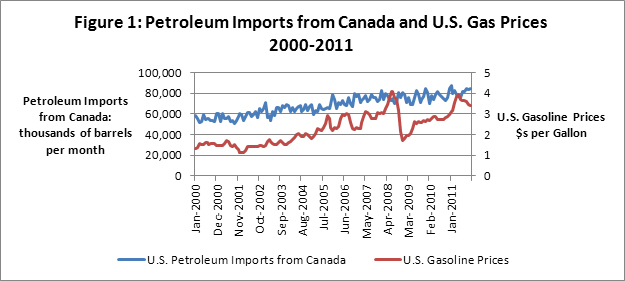
The increase in both the actual and the capacity for Canadian petroleum imports has not made the slightest difference to the general trend of rising oil and gasoline prices. (See Figure 1 below) This is not a surprise. Oil is a global commodity and there are simply bigger things going on in the oil world than the steady increase in Canadian oil production. The problems mentioned above have a greater influence on global prices, as does the steady increase in demand in emerging economies. That a seventh pipeline (Keystone XL) from Canada to America can make a significant impact just does not bear serious scrutiny.

Table 1: The total capacity of Oil Pipelines from Canada to the United States
Pipeline Capacity (barrels per day)
Express 280,000
Bow/Milk River 129,000
Rangeland 83,000
Enbridge Mainline 2,050,000
Enbridge Alberta Clipper 800,000
TransCanada Keystone I 590,000
Total 3,932,000

Figure 1 shows that throughout the last 11 years, petroleum imports from Canada have steadily risen from below 60 million barrels per month at the beginning of the last decade to over 87 million barrels per month at its peak in early 2011, a 50% increase. Yet, gas prices have trebled with spikes and troughs along the way that clearly have little to do with the steady rise in imports from north of the border.

Exports: where the oil goes matters

Another factor that undermines the assertion that building a seventh pipeline from Canada will somehow change this dynamic is the nature of the market in the Gulf Coast where the pipeline would terminate.

As we have discussed several times before on this blog, the Gulf Coast is becoming a refining center as much focused on exports as it is on supplying the domestic market. It is therefore unclear how much of the pipeline’s deliveries will actually make it onto the domestic market. This makes it even less likely that this pipeline will be any better than the six others at affecting U.S. gas prices.

The latest figures for exports from the refining area known as PADD 3, which encompasses all of Texas, Louisiana, Arkansas and New Mexico, show that 32% of the region’s production of finished petroleum products was exported in November.

So while the industry and its supporters ply their misinformation regarding the gas price reducing attributes of their pet project, it is worth noting that the real action that has been taken to ease the pain of inevitable oil price rises over the coming years is mostly being ignored.

Efficiency: where the real action is at

The fuel efficiency standards passed by the administration will save more oil than Keystone XL will ever pump. They could cut oil use by 2.2 million barrels per day in 2025 while Keystone would at full capacity deliver 830,000. These efficiency programs will save Americans billions of dollars at the pump and genuinely ease the pressure of spiking global oil prices. There is a lot more that can be done to reduce America’s dependence on oil, but these standards are a great start.

But while more efficient vehicles mandated under the new standards are entering the market this year, obviously only a small percentage of the population will be able to make use of them this summer when prices are expected to spike.

What appears to be missing from the discussion on both sides is a plan for action to help consumers deal with this year’s price spike. We know it’s coming but where’s the plan to deal with it?

President Obama has pointed to the pay roll tax extension as a help, but that is merely a continuation of tax policy that consumers have been enjoying for some time, welcome though it may be. Others have called for releases from the Strategic Petroleum Reserve, a band aid at best.

What we should be seeing is a concerted effort to help people reduce their oil use through every means available. Online tools for carpooling, incentives from employers, private and public, to use them. Increasing public transit provision where possible and providing information and incentives for those that can make use of transit; these are just a few examples that could make a big difference this year. We need to see recognition and action from local authorities and major employers that gas prices will be a problem for the public this year and that there are actions that can be taken.

When gas prices spiked in 2007-2008, Americans took to transit and carpooling in large enough numbers to precipitate the first dip in vehicle miles travelled in nearly thirty years and the biggest spike in transit use since the 1950s. This is bound to happen again this year but there is surely more we can do to facilitate it and after all, it is not just a short term salve but a major part of the long term solution.

Friday, February 24, 2012

Fred's Blog: Obama Wants Five Dollars per Gallon — and More

Fred's Blog: Obama Wants Five Dollars per Gallon — and More

“Addiction” implies an intense desire for something harmful, such as heroin. But we do not desire oil irrationally; we consume it because it is a beneficial, life-sustaining product. Oil is unmatched as a concentrated, safe, and

Oil powers the industrial farm equipment that brings us abundant food; oil powers the mobile machinery that we need to extract the raw materials like iron, lumber, uranium, or natural gas from the earth.

Oil powers the construction equipment we need to build new buildings, dams, levees, factories, and homes.

Oil powers the hundreds of millions of vehicles that move people, materials, and products around the world to make possible the efficiency of our integrated, global economy.

Oil is also the vital raw material for thousands of different petroleum products: from the carpet on your floor to the insulation inside your walls; from the synthetic rubber of your tires to the asphalt of the roads; from the pesticides and fertilizers that magnify crop yields and make food affordable to billions, to the pharmaceuticals that save millions of lives.

We are not "addicted" to oil any more than we are addicted to the myriad values it makes possible, like fresh food, imported electronics, going to work, or visiting loved ones.

Without oil, or something just as potent, abundant, and affordable, life as we know it would be impossible.

The 6 Myths About Oil | Fox News

The 6 Myths About Oil | Fox News

The 6 Myths About Oil

By

Published December 29, 2010

Myth #1: America’s reliance on oil is an “addiction”—an irrational, self-destructive habit.

“America is addicted to oil.” –George W. Bush, 2006

The Reality: America’s use of oil brings indispensible value to our lives.

“Addiction” implies an intense desire for something harmful, such as heroin. But we do not desire oil irrationally; we consume it because it is a beneficial, life-sustaining product. Oil is unmatched as a concentrated, safe, and affordable source of portable energy. And our lives depend on such a source of energy.

- Oil powers the industrial farm equipment that brings us abundant food; oil powers the mobile machinery that we need to extract the raw materials like iron, lumber, uranium, or natural gas from the earth.

- Oil powers the construction equipment we need to build new buildings, dams, levees, factories, and homes.

- Oil powers the hundreds of millions of vehicles that move people, materials, and products around the world to make possible the efficiency of our integrated, global economy.

- Oil is also the vital raw material for thousands of different petroleum products: from the carpet on your floor to the insulation inside your walls; from the synthetic rubber of your tires to the asphalt of the roads; from the pesticides and fertilizers that magnify crop yields and make food affordable to billions, to the pharmaceuticals that save millions of lives.

We are not "addicted" to oil any more than we are addicted to the myriad values it makes possible, like fresh food, imported electronics, going to work, or visiting loved ones.

Without oil, or something just as potent, abundant, and affordable, life as we know it would be impossible.

Myth #2: There are “green” technologies that are just as good, or better, than oil.
“The way to bring gas prices down is to end our dependence on oil and use the renewable sources that can give us the equivalent of $1 per gallon gasoline.”
“…we can start right now using solar power, wind power …”
– Al Gore, 2008

The Reality: There is zero evidence that any “renewable” can replace oil in any foreseeable future.

For decades, the Al Gores of the world have claimed to know how to supplant oil. In 1977, Jimmy Carter proclaimed that in order to combat “too much demand for fuel that keeps going up too quickly,” America would “develop permanent and reliable new energy sources. The most promising, of course, is solar energy, for which most of the technology is already available.”

Since then, solar, wind, as well as biofuels—fuels derived from vegetable and animal sources—have received extravagant subsidies in America and throughout the world. And yet America uses more oil than ever, while Americans get less than 2% of their energy from solar solar and wind combined, and less than 4% of their energy, including transportation fuel, from biofuels and other plant and animal sources.

Why? Because solar, wind, and biofuels have proven utterly incapable of matching two of oil’s key virtues: low price and enormous abundance. They are expensive and nearly impossible to scale—largely because they all use highly diluted sources of energy that take far more land and equipment to process and transport than does oil (or other fossil fuels).

To attempt to implement these on a large scale would bankrupt Americans through home and business electricity costs alone—to attempt add a new generation of electric cars to the mix would make the costs and scarcity that much greater.

To make matters worse, solar and wind cannot even provide reliable, expensive electricity, because they use inherently intermittent sources of power--sunshine and wind gusts. Whereas coal, natural gas, and nuclear can generate the massive, precise, and reliable flows of power a modern economy require, wind and solar cannot—which is why they are always used as auxiliary, not primary, sources of power on electric grids. Think about it: Would you want your parent’s hospital room powered by the wind?

As for biofuels—fuels generated from crops or animal waste—they are generally very expensive because it costs a lot of money to extract diffuse energy from piles of manure or ears of corn, vs. the highly concentrated energy in a barrel of oil.

Biofuels typically require hundreds of gallons of water per gallon of output produced, while a gallon of oil requires five gallons of water. Further, they are very difficult to scale because they require massive amounts of expensive land, and the best ones require the best cropland. This is why Brazil, home of the most efficient and in-demand biofuel production (sugar-cane ethanol), produces the oil equivalent of less than 1.5% of the US’s consumption.

By far the most viable, large-scale non-CO2-emitting energy source is nuclear power, which environmentalists have set back decades and kept expensive through scare-mongering and a nearly insurmountable approval process. Thus, while dependence on nuclear power will likely grow in the coming decades—right now it supplies only 20% of U.S. electricity—it would take decades before it could economically replace a large percentage of the energy now supplied by coal and natural gas plants, let alone the 40% of U.S. energy supplied by oil.

Calls to cap 80% of oil (let alone all fossil fuels) and replace it with sunshine, wind gusts, vegetables, and manure piles are tantamount to economic suicide. This would drain the lifeblood of our civilization without offering a transfusion.

Myth #3: Because oil is finite, it will inevitably run out.

“The amazing exhibition of oil is a temporary and vanishing phenomenon, one which young men will live to see come to its natural end.” –State Geologist of Pennsylvania, 1885.

Reality: There’s a lot more oil than you think—and if we have a free market in energy we will ensure that we find superior substitutes long before we run out.

Since the beginning of the oil industry, oil doomsayers, including prominent geologists, have been claiming that oil was running out, and would soon would run out or go scarce; in every case, oil supplies in general have increased.

A typical example: in 1939 the Department of the Interior forecast that U.S. oil supplies would be exhausted by 1952; 30 years later, not only had oil production not run out, it had tripled.

The year 2009 was one full of talk of “peak oil,” and yet some of the most momentous, unexpected oil finds in history, especially in Brazil, followed each announcement.

Why are the “experts,” so often wrong, and what can be expected for the future?

One reason is that the “experts” routinely neglect or underestimate the capacity of the human mind to discover better methods of locating and extracting oil. In industry parlance, they falsely equate “proven reserves”—the amount of oil that is known to exist and be extractable in the present—with future production: the amount of oil that will be known and be extractable in the future.

This is a fallacious tactic. As a rule, in the future companies will have the knowledge and economic incentive to discover and harness oil that they do not have the knowledge and incentive to discover today. Oil companies locate new oil supplies as and when it makes sense to do so given their production projections and given market supply and demand. They have no way of knowing the total amount of oil that exists in the earth, and no need go to the expense of finding and validating any given new deposit until it is profitable to do so.

Over time, as demand increases and/or previous reservoirs becoming exhausted, the industry locates new oil and discovers new and better ways to extract it. For example, oil companies can now discover deposits thousands of feet below the ocean floor using 3-D magnetic imaging; they can extract many times the oil from a reservoir that they once could, using methods such as horizontal drilling or high-pressure gas and water injection; today’s “easy oil” was yesterday’s “impossible” oil.

The upshot? Despite decades of doomsaying, and even despite major restrictions on drilling in the U.S. and in other countries, the state of affairs is still one of growing production and ample supplies for decades to come. As oil economist Michael Lynch explained, as of 2009
…the consensus among geologists is that there are some 10 trillion barrels out there. A century ago, only 10 percent of it was considered recoverable, but improvements in technology should allow us to recover some 35 percent -- another 2.5 trillion barrels -- in an economically viable way. And this doesn’t even include such potential sources as tar sands, which in time we may be able to efficiently tap.

But surely oil supplies will run out or go scarce at some point? No—because at the same time that entrepreneurs have every incentive to develop more oil, they have every incentive to develop substitutes for oil (especially as oil prices rise). Oil itself was originally a substitute lamp oil for whale oil and animal oil, and then was replaced by the superior electric light-bulb. Oil was once a major source of electricity; it was superseded by coal and natural gas, which were better sources for fixed power generation.

To the extent it becomes expensive to extract oil from the earth in sufficient quantities, we can be sure that entrepreneurs will work to make substitute sources of fuel based on legitimately promising technologies, such as natural gas or coal, or that they will seek to create battery-powered vehicles charged with nuclear power or some yet undeveloped technology—to the extent that the government refrains from its policy of heavily restrict mining, drilling, and nuclear technology. It is government policy, not the finite quantity of any given raw material, that is the real threat to future energy supplies.

The upshot: we will never run out the energy we get from oil--unless we run out of freedom.

Myth #4: Because oil is mostly in other countries, they can cut us off at will and create an economic catastrophe.
“…think of the instability and the impotence you feel knowing that every day we have to have a lifeline from places half a world away that could cut us off in a minute.” –Bill Clinton, 2006.

Reality: International trade makes our energy supply more secure—and far more affordable.

Two-thirds of the oil Americans use is imported from other countries. This state of affairs is often derided as America’s “dependence on foreign oil,” conjuring up thoughts of being helplessly at the mercy of Saudi Arabia. But our relationship with foreign companies is not some helpless dependence—it is trade that is vital to the interest of all involved. Canada, Nigeria, Saudi Arabia, and Mexico do not sell oil to the U.S. and other countries as an act of charity that they can effortlessly revoke; they do it because it is economically vital to their survival.

The idea that we are perpetually at the mercy of Saudi Arabia simply shutting off its spigots, which would be complete suicide for a country whose whole economy relies on oil, is absurd.

By the same token, it’s crucial to realize that we buy oil because it provides the value it does cheaper and better than anything else—and we buy oil from foreign countries because given present knowledge and technology, it is far, far cheaper to do that than to try to produce all of Americans’ oil consumption domestically. (However, this is no way justifies America’s anti-development drilling restrictions in Alaska and on the Outer Continental Shelf, which should be lifted.)

To be sure, temporary supply disruptions are possible, whether due to political machinations or natural disasters—but in such cases free, international trade is the solution, not the problem. Higher oil prices resulting from decreased supply would spur new production (of oil or viable substitutes) among trading partners worldwide and limit consumption to its most valued uses.

In general, trade with other countries vastly increases our economic well-being and security. It affords us access to the cheapest oil sources in the world, and offers us more options in the event that some production is stopped. During Hurricane Katrina, our “dependence on foreign oil” was vital to getting much-needed supplies of gasoline to the Gulf Coast when U.S. refineries shut down.

This is not to say that the current possession of oil by unfriendly or outright militant dictatorships is an ideal state of affairs--but the foreign policy mistakes that brought it are not solved by withdrawing from international trade.

Myth #5: Because oil money funds hostile dictatorships (Iran, Saudi Arabia) by using less oil we can make them poorer and make ourselves more secure.

“If President Bush made energy independence his moon shot, he would dry up revenue for terrorism [and] force Iran, Russia, Venezuela and Saudi Arabia to take the path of reform…” --Thomas L. Friedman, The New York Times, 2004

Reality: Direct threats to America must be fought through direct and decisive military action—not through multi-decade, sacrificial schemes to lower oil prices.

Iran and Saudi Arabia use ill-gotten profits to spread totalitarian Islamic ideology around the world and terrorize us with their minions. This, however, in no way justifies any attempt at “energy independence”—that is, renouncing international trade in energy, including the two-thirds of our oil we buy on the international market.

If, say, Iran's money is the problem, then the solution is to cut off Iran's money directly--for example, by organizing a global economic boycott against Iranian oil (not "foreign oil"). Why on earth should we give up two-thirds of the oil we need, an incalculable economic sacrifice? It is self-sacrificial and xenophobic to try to end our reliance on foreign oil as such and retreat into some kind of oil subsistence farm, in the hopes that this would someday lower Iran’s oil revenues. (This is especially dubious given skyrocketing oil demand from India and China.) It is an undeniable fact that Iran was an active, blossoming sponsor of terrorism when oil was at $10 and $20 a barrel (as was Saudi Arabia)—can anyone possibly believe that focusing on lowering oil prices over a period of decades would accomplish anything besides giving Iran more time to develop nukes, while undermining America’s economy and military?

Myth #6: Because the burning of oil produces CO2, oil is a deadly pollutant that must be severely capped.

“As President, I will set a hard cap on all carbon emissions at a level that scientists say is necessary to curb global warming-- an 80% reduction by 2050.” --Barack Obama, 2007

Reality: Carbon-caps, not carbon emissions, are the real deadly threat to human life.

It is taken for granted that any negative impact that results as a byproduct of burning oil and fossil fuels is a justification for limiting fossil fuels—even by the U.N.’s widely-accepted figure of 80%.

But this utterly evades the benefits we get from oil and fossil fuels that cannot be substituted for on any foreseeable timetables by the “green” technologies favored by environmentalists. (See Myth #2.)

Fossil fuels supply 85% of our energy—the energy that makes the difference between a 40-year life expectancy and an 80-year life-expectancy, the energy that protects men from thunderstorms, rising sea levels, temperature extremes, drought, etc. Whether or not global warming proves substantial, these are problems that confront any society, and only industrial-scale energy is capable of solving. Thus, we need to factor into our thinking the benefits of increased CO2 energy and the harms of slashing oil and fossil fuel use by 80%. And, as we have seen, there is no evidence of any viable “green” substitute for oil.

Loose talk of a “climate change catastrophe” evades the fact that industrial energy makes catastrophes non-catastrophic. In Africa, a drought can wipe out hundreds of thousands of lives thanks to that continent’s rejection of capitalism and resultant lack of industrial energy.

In America, we irrigate so well that deserts have become the most desirable places to live (think Southern California and Las Vegas).

Economic freedom, not climate, is the fundamental determiner of human well-being. Left free to discover and harness energy, human beings can adapt to any change in weather. But there is no adapting to a mass, government-created drought of energy. There are already 1.5 billion people in the world who live without electricity. What they need is not a stagnant average global temperature; they need capitalism, including cheap, affordable fossil fuels.

The 6 myths about oil all count on the fact that we have not been taught to truly value or understand oil, the oil industry, and the capitalist system that have made them so prominent.

How often do we hear that oil is a source of incredible value to human life, past, present, and future? How often do we hear about of the forward-looking ingenuity of the oil industry and other energy industries to keep finding new and better ways to harness raw materials from the earth. How often do we hear about the great benefits of international trade in energy? Almost never.

It’s time to start talking about these positives and talk about liberating, not restricting, oil production. Otherwise, in the name of being “clean” and “green” we will adopt policies that will sentence ourselves and our children to energy poverty.

Alex Epstein is a fellow at the Ayn Rand Center for Individual Rights, focusing on business issues. The Ayn Rand Center is a division of the Ayn Rand Institute and promotes the philosophy of Ayn Rand, author of “Atlas Shrugged” and “The Fountainhead.”

Every American consumes an average of three gallons of oil a day. Republicans and Democrats call this reliance on oil an “addiction”—an irrational, self-destructive habit that must be broken as soon as possible. This year's BP oil spill disaster is only making the chorus to “end our addiction to oil” louder. But if we examine the most common arguments for this idea, we see that they are myths. Oil is a vital, viable, and desirable part of our energy future.

Thursday, February 23, 2012

IER Analysis: Oil and Gas Production Declines on Federal Lands in FY2011

IER Analysis: Oil and Gas Production Declines on Federal Lands in FY2011 Oil

Posted February 23, 2012
“EIA has included information on the production of oil and natural gas on federal lands in the AER that significantly under-represents what is actually occurring:” letter from Rep. Edward Markey to Howard Gruenspecht, Acting Administrator of the Energy Information Administration.
Representative Edward Markey (D-Mass.) recently sent a letter to the Energy Information Administration (EIA) requesting the agency fix a problem with oil and gas production data on federal lands it reports in the Annual Energy Review (AER). Markey’s interest in writing to EIA was to indicate that the production volumes reported on federal lands by EIA were low, and to point out that production rose in fiscal year 2010, rather than declined as the EIA data showed and as the Institute for Energy Research (IER)[ii] and the Heritage Foundation reported on their websites.
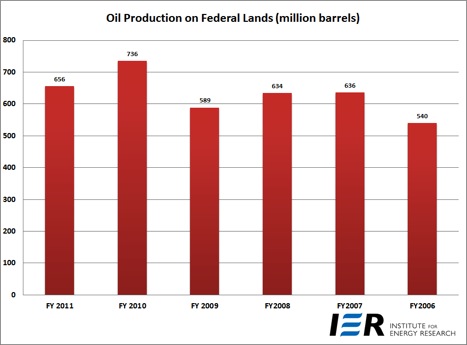
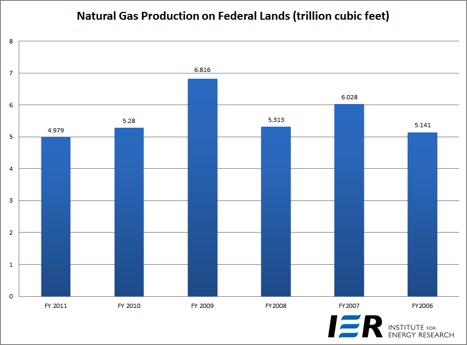
EIA has yet to correct its reporting problem, and is waiting on the Department of the Interior (DOI) to provide correct data. In the meantime, IER painstakingly generated the available data for fiscal years 2006 through 2011 from reports buried in the Department of Interior’s website[iii]. IER found that oil production on federal lands in FY2011 did, in fact, decline from the fiscal 2010 level and natural gas production on federal lands declined in FY2010 and then again in FY2011. While the Administration is correct that oil and gas production in the United States is rising, the data show that where the federal government was in charge oil and gas production fell last year on taxpayer-owned lands.
What Does the ONRR Data Show?
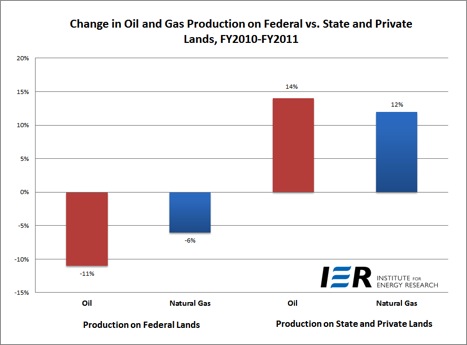
In FY2011, oil and natural gas production on federal lands declined from their 2010 levels: oil production on federal lands declined by 11 percent and natural gas production on federal lands declined by 6 percent. Meanwhile, there was a 14 percent increase for oil production on private and state lands and a 12 percent increase for natural gas production on private and state lands.


Sources: Department of the Interior, Office of Natural Resources Revenue, http://www.onrr.gov/ONRRWebStats/ExportReport.aspx?report=AllNonRevenueVolumesByCategoryAndCommodity&yeartype=FY&year=2011&datetype=AY and http://www.onrr.gov/ONRRWebStats/Disbursements_Royalties.aspx?report=AllReportedRoyaltyRevenues&yeartype=FY&year=2011&datetype=AY
Moreover, natural gas production on federal lands in FY2011 declined by 27 percent from its FY2009 level, when it peaked at 6.82 trillion cubic feet, while natural gas production on state and private lands increased 28 percent over that time period.

Sources: Department of the Interior, Office of Natural Resources Revenue, http://www.onrr.gov/ONRRWebStats/ExportReport.aspx?report=AllNonRevenueVolumesByCategoryAndCommodity&yeartype=FY&year=2011&datetype=AY and http://www.onrr.gov/ONRRWebStats/Disbursements_Royalties.aspx?report=AllReportedRoyaltyRevenues&yeartype=FY&year=2011&datetype=AY
The above trend indicates the Obama Administration policies that IER reported are causing lower oil and natural gas production on taxpayer-owned lands.[iv] These policies include limiting the offshore areas where oil can be produced, leasing much less land than previous administrations, cancelling oil leases, withdrawing oil leases and slow-walking the issuance of permits that allow domestic energy production. (For more of the Obama administration’s anti-energy actions, click here.)
Data Issues
In obtaining the data for this analysis from the DOI’s Office of Natural Resources Revenue (ONRR) website, IER noted the following:
  • Data were unavailable on the ONRR website for non-revenue production on federal lands prior to fiscal year 2006. IER received the following message when asking for fiscal year 2005 data: “An error has occurred while processing your request. Please try again. If the problem persists, please contact MMS Customer Support at 1-877-256-6260. When speaking with customer support, a federal official stated that “an error has occurred in the MRM Statistical Reporting application.”
  • The data given to Rep. Markey by ONRR is different from what is reported on the agency’s website. For example, in his letter to EIA, Rep. Markey indicated that non-revenue oil production on federal lands in FY 2010 was 312 million barrels, but the ONRR website reports 351 million barrels.
  • Non-revenue production volumes by fuel type are not evident on ONRR’s statistical website. For more about ongoing data transparency issues at the Department of Interior, click here.
Conclusion
Rep. Markey was right to ask the U.S. Energy Information Administration to correct its information in the Annual Energy Review, which are not easily obtainable from the Department of Interior either by the general public or by other federal agencies or the Congress. And while the data disparity noted in Rep. Markey’s letter may lead some to believe that EIA’s under-reporting of production on federal lands gives cover for failed Obama administration policies, the facts remain unchanged. Production on federal lands is down, while production on state and private lands is up.
Indeed, if ONRR’s data volumes are correct,there are abundant reasons to believe that current policies holding public lands captive from resource development serve to make federal lands increasingly unattractive to energy producers. Our nation needs to produce energy, revenue and especially, jobs. Meanwhile, state and private lands are rapidly increasing energy production. There is clearly a need for policy changes that encourage energy production on federal government lands.


[i] Letter from Rep. Markey to EIA Acting Administrator Gruenspecht, January 26, 2012, http://democrats.naturalresources.house.gov/content/files/2012-01-06_LTR_MarkeytoEIA.pdf
[ii] Institute for Energy Research, Oil and natural gas production on federal land is declining, November 15, 2011, http://www.instituteforenergyresearch.org/2011/11/15/falling-production-on-federal-lands/
[iv] Institute for Energy Research, Fact Checking President Obama’s Claims About Domestic Energy production, January 20, 2012, http://www.instituteforenergyresearch.org/2012/01/20/fact-checking-president-obamas-claims-about-domestic-energy-production/

Gibson Guitars: Six Months Later. - Tea Party Nation

Gibson Guitars: Six Months Later. - Tea Party Nation

Gibson Guitars: Six Months Later.

Gibson Guitars, a company who's CEO, Henry Jusckiewicz, generally supports Republicans, has been raided and harassed twice during the last 39 months. The reason the Obama Administration used to effectively harm Gibson Guitars was the centuries old Lacey Act. This is an act that was passed originally to insure that fisherman and trappers from the U.S. would not travel to Canada and violate Canadian Law in order to sell Canadian fish and wild life here in the U.S. It was passed as a part of one of the first trade treaties between our two nations. Like all good acts passed by our Congress and enforced by the cabal of bureaucrats hired to oversee such things, it has grown in scope beyond not only its original intention, but also any reasonable interpretation by those of us who inhabit reality.

Gibson was raided because of some wood imported from Madagascar in 2009, and again in August of 2011, this time pertaining to rosewood imported from India. In either instance, the Government has yet to file charges. The net cost to Gibson so far is several Million Dollars in confiscated materials, productive closures and lost sales. Gibson of course wants her day in court. Gibson has been denied due process and her right to a speedy trial.Part of the reason Gibson has been denied her Fourth and Sixth Amendment rights is that the Obama Administration knew, even before going on this witch hunt, that they were wrong.

Andrea Johnson, who represents the Environmental Investigative Agency, the part of the EPA tasked with enforcing their little corner of the Lacey Act, (this sentence right here should be all the proof needed to show that both the Lacey Act and the EPA have grown beyond any reasonable description of their actual intent,) made some interesting statements during this video. She stated that, "it's not up to Gibson or any other company which laws of other countries they're going to respect. This is an issue about the mutual respect for law around the world, and that's what the Lacey Act says. That's the principle behind the Lacy Act."

I say let's take what Johnson says at face value. In fact, on this statement, I agree whole heartedly. The problem arises in her stance of course when both Madagascar and India have already come forward in Gibson's defense, prior to the raids, and stated that Gibson acted honorably and obeyed all of their laws in this and every other matter. It is Johnson, and the EPA who have shown no respect for the law, as her raids on their facility were a clear violation of the Fourth Amendment, not filing any charges in over three years is a violation of the Sixth Amendment. Add to this that it also stands to reason that it is not up to Johnson or any other Obama Administration official which laws of foreign nations that they are going to enforce as well. Let us not forget that in addition to harming Gibson, they have also harmed Madagascar and India, both countries who wish to continue doing business with Gibson Guitars. That she was able to make that statement with a smug little smile on her face merely adds salt to the wound that is the Obama Administration.

Johnson went on to say, "do individual musicians need to worry about the Lacey Act and about declaring their individual instruments when crossing international borders? The simplest answer is no....The government has no intention of enforcing the Lacey Act against individual owners of musical instruments." What she of course fails to mention is that other people who are not musicians are subject to those very stiff regulations, which are certainly obscure. This is a law with real teeth by the way, as the fines start off at $100,000, and hard time in the Federal Penn. How many of you fish? What kind of wood was used in your fishing rod? Where did the wood come from? I live on Lake Erie, and often times end up fishing in Canadian Waters, as many Canadians fish here in America. The fact is, the Lacey Act has been enforced already against individuals, maybe not musicians, but others for certain. The other point is this. Even if she magnanimously decides to allow guitar players to slide, they are still in violation of the law should they fail to make the Lacey Act declaration. Just because Andrea Johnson is so selectively gracious as to allow musicians to violate the laws enforced upon the rest of us, does not mean that the next Obama Appointee will feel the same way.

This case, as well as any other, highlights the true hideous nature of the leftists in charge. They take what little authority they do have, and they find ways to add to their scope, and size. "I control this little corner of the world, and I want more." We the people, and our consent to be governed are nothing more than an annoyance to them. That outdated document upon which our nation was founded is something to be done away with, as the founding fathers messed up by not just granting these smug little bureaucrats the authority to rule as they see fit.

Cross Posted at Musings of a Mad Conservative.