Cassie
Slade, of he Fox Tuttle Hernandez Transportation Group, checks the flow
rate of cars southbound through the intersection of Folsom Street and
Canyon Boulevard on Tuesday evening to help test the effects of the
"right-sizing" changes on traffic. (Paul Aiken / Staff Photographer)
Boulder
City Council members criticized the community for the vitriolic tone of
emails they had received from both sides of the "right-sizing" issue,
before backing a transportation staff recommendation to remove protected
bike lanes and return to four lanes of vehicle traffic on four blocks
of Folsom Street.
"It's hard to go to sleep at night because you've been insulted so
badly," Councilwoman Mary Young said Tuesday night. "I feel like I'm
living among a bunch of people who feel entitled to their own without
consideration for others. I want you to think about that."
Councilwoman Lisa Morzel, who pushed for the city to roll back the
right-sizing project, said the tone of the debate had set back the cause
of bicycle infrastructure, and she criticized bicycle advocates dressed
in black who were tweeting about the meeting from the front row.
"My concern with all this vitriol is that it pushes everyone into
their own corners and it pushes us backwards, and we can't make progress
on bike and pedestrian safety," she said.
But Morzel rejected the idea that the city is "abandoning" the Folsom project.
"That is not the case," she said.
Just a month before, a majority of council members supported
continuing the project for at least a year with relatively minor changes
— such as removing bollards, lengthening turn lanes and changing
landscaping — and gathering data on how well it was working. The project
was conceived as an experiment to try a street design that had been
tried in many other cities to see how much it improved safety and bike
ridership along the corridor.
Advertisement
But the project sparked an intense backlash from drivers who faced traffic jams, especially during the afternoon rush hour.
Go Boulder Manager Kathleen Bracke said the average delay was just 76
seconds on the southbound side, but travel times were highly variable
and some trips took much longer.
Last week, city transportation staff members recommended returning
that portion to four lanes because minor modifications had not made a
noticeable difference in travel times, snow removal plans might not work
well and businesses felt customers were being driven away.
The protected bike lanes on Folsom will remain from Pine Street
north to Valmont Road, with the block between Pine and Spruce being a
transition zone, and from Arapahoe Avenue south to Colorado Avenue.
Councilman Sam Weaver said the portions of the project that do the
most to improve safety will remain. Traffic speeds are higher north of
Pine, and cyclists will still benefit from protection there.
Councilman Andrew Shoemaker said right-sizing was an experiment, and
it has worked as such in that the city learned a lot. He called the
return to four vehicle lanes in the central part of the corridor a
"minor tweak."
Councilman Tim Plass supported the staff recommendation but not without hesitation.
"By truncating this project, we're going to lose some really valuable
data from that section of the road," he said. "I hope we find ways to
redouble our efforts to meet our goals for bikes in the transportation
master plan."
Councilwoman Suzanne Jones said she would "reluctantly" support the
return to four vehicle lanes and said she hoped transportation planners
would still bring forward innovative ideas, but with more public
outreach beforehand.
"The direction is not to be less bold but perhaps to be more strategic," she said.
Bracke said the lessons learned on the Folsom Street corridor could
be incorporated into design guidelines for bicycle lanes in other
corridors.
Council members said the city should look at possible changes on 19th
Street and 30th Street to improve bicycle safety along north-south
corridors.
"The public is now on notice that we're going to do these interesting projects, and we want your input early on," Jones said. Erica Meltzer: 303-473-1355, meltzere@dailycamera.com or twitter.com/meltzere
Max Ritter rides his bike south through the intersection of Folsom Street and Canyon Boulevard on Tuesday evening. (Paul Aiken / Staff Photographer)
Obama is a product of, and whose actions reflect what David Horowitz described as an unholy alliance, between the American left and radical Islam.
They have been brought together by
the one overriding trait they share – their contempt for the United
States, their belief that our country is the very embodiment of evil on
earth and, therefore, must be destroyed. While Islamic radicals seek to
purge the world of heresies and of the infidels who practice them,
leftist radicals seek to purge society’s collective “soul” of the vices
allegedly spawned by capitalism — those being racism, sexism,
imperialism, and greed.
Obama’s statism and economic policies appear to be taken directly out of the Marxist-Leninist playbook of
his childhood mentor, American communist Frank Marshall Davis, whose
newspaper columns advocated wealth redistribution, government stimulus
for “public works projects,” taxpayer-funding of universal health care,
and nationalizing General Motors. Davis’s writings, riddled with racism
and resentment, denounced the “tentacles of big business,” blasted Wall
Street and “greedy” millionaires, lambasted GOP tax cuts that “spare the
rich,” attacked “excess profits,” and often called for transformational
and fundamental “change.”
Not only was Obama member and candidate of the 1990s Chicago socialist New Party; he has emulatedVladimir Lenin in striving to increase state control over important sectors of the American economy such as energy, health care,finance, and education— and with smaller interventions in food and transportation. In addition, the broader policies of the Obama Administration and his congressional progressive fellow-travelers bear comparison to Karl Marx’s ten point plan for incremental socialism.
Obama was registered at a Catholic school in Jakarta as “Barry Soetoro” and was listed as
having Indonesian nationality and a member of the Muslim religion. In a
conversation with George Stephanopoulos in September 2008, Obama spoke
of “my Muslim faith,” only changing that to “my Christian faith” after
Stephanopoulos interrupted and corrected him.
<br/>
Obama has often expressed his affection for Islam:
“We
will convey our deep appreciation for the Islamic faith, which has done
so much over the centuries to shape the world – including in my own
country.”
“We’ve seen those results in
generations of Muslim immigrants – farmers and factory workers, helping
to lay the railroads and build our cities, the Muslim innovators who
helped build some of our highest skyscrapers and who helped unlock the
secrets of our universe.”
“These rituals
remind us of the principles that we hold in common, and Islam’s role in
advancing justice, progress, tolerance, and the dignity of all human
beings.”
“Islam is not part of the problem in combating violent extremism – it is an important part of promoting peace.”
“The sweetest sound I know is the Muslim call to prayer”
And, most recently at a dinner to mark the celebration of Eid-al-Fitr on July 27, 2014, Obama thankedMuslim
Americans for their many “achievements and contributions… to building
the very fabric of our nation and strengthening the core of our
democracy.”
Obama’s friendship with Khalid Abdullah Tariq al-Mansour and
his sponsorship of Obama as a prospective Harvard law student probably
helped harden Obama’s Islamist, leftist, black-nationalist, and
anti-American views. It is likely that Obama, while attending Columbia
University, became closely associated with al-Mansour, when the latter
was invited to lecture by Obama’s Columbia professor and later friend,
the Yasser Arafat apologist and Israel-hating Edward Said.
Formerly known as Donald Warden, al-Mansour,
an American, was a mentor of Black Panther founders Huey Newton and
Bobby Seale in the early 1960s. He changed his name after studying Islam
and learning Arabic. He is well known within the black community as a
lawyer; an orthodox Muslim’ a black nationalist; and an outspoken enemy
of Israel, the United States, and white people, in general. His writings
and books are filled with anti-American rhetoric. Al-Mansour is a
personal advisor to Saudi Arabian Prince Alwaleed bin Talal, the world’s
19th wealthiest person, part-owner of News Corp (Fox News), and the individual who allegedly funded Obama’s Harvard education.
Obama’s
apparent respect for and adherence to beliefs so divergent from
America’s history and traditions raise questions concerning their
influence on the formulation of his policies, whose effects appear to
have had such a clearly negative impact on American society and national
security.
Stated simply, did we elect the enemy?
Is Obama’s current Middle East policy, for example, seemingly contrary to American interests, designed to inhibit Israel, bolster Hamas, and return the Muslim Brotherhood to power in Egypt?
As
bad as Obama might be for the country, he is only a manifestation or
symptom of a deeper, more corrosive problem: our corrupt political-media
culture.
If we had an honest federal government with an unbiased
media, Obama would still be voting “present” in the Illinois state
legislature.
If Barack Obama is permitted to complete his term of
office, it will be an endorsement of permanent political and media
corruption in the United States.
Because man-made climate change is at the center of
liberals’ and environmentalists’ entire political ideology, it’s
essential that the idea be considered fact.
Even if it’s not.
SO when numbers come in from weather stations around the country that
either disprove the entire notion of “global warming” or “climate
change,” something needs to be done.
So what’s done? They change the numbers. Easy-peasy.
Researcher John Goetz analyzes the difference between the “raw”
measurements recorded by weather stations and the “official” ones that
end up in the record books. And he noticed something interesting. They
change:
Goetz finds that approximately 92% (or even more, depending on how
you calculate it) of US surface temperature data consists of estimated
or altered values. Very little raw data finds its way into the warmists’
climate models–which, of course, is the way they want it. Second, the
adjustments that are made to the U.S. data consistently skew the numbers
as we have described many times before–they try to make the present
look warmer, compared with the past.
Why would they do this? There’s a lot of money in climate change and if
these alarmists can’t prove the planet’s warming up and it’s OUR fault,
the money dries up.
Here’s what the average temperature at various weather stations in
the United States looks like for the last ten years. See any warming?
No? Shhh…
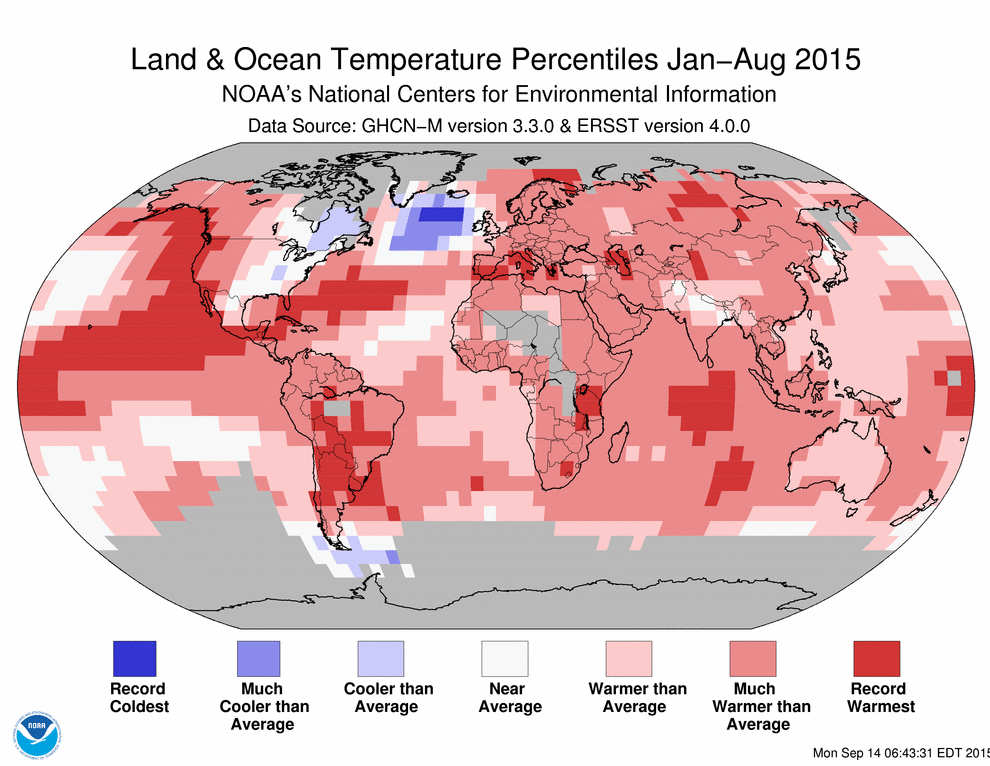
January–August 2015 Blended Land and Sea Surface Temperature Percentiles. (NOAA)
It is, for our home planet, an extremely warm year.
Indeed, last week we learned from
the National Oceanic and Atmospheric Administration that the first
eight months of 2015 were the hottest such stretch yet recorded for the
globe’s surface land and oceans, based on temperature records going back
to 1880. It’s just the latest evidence that we are, indeed, on course
for a record-breaking warm year in 2015.
Yet, if you look
closely, there’s one part of the planet that is bucking the trend. In
the North Atlantic Ocean south of Greenland and Iceland, the ocean
surface has seen very cold temperatures for the past eight months.
What’s up with that?
First
of all, it’s no error. I checked with Deke Arndt, chief of the climate
monitoring branch at NOAA’s National Centers for Environmental
Information, who confirmed what the map above suggests — some parts of
the North Atlantic Ocean saw record cold in the past eight months. As
Arndt put it by email:
For the grid
boxes in darkest blue, they had their coldest Jan-Aug on record, and in
order for a grid box to be “eligible” for that map, it needs at least 80
years of Jan-Aug values on the record.
Those grid boxes encompass the region from “20W to 40W and from 55N to 60N,” Arndt explained.
And
there’s not much reason to doubt the measurements — the region is very
well sampled. “It’s pretty densely populated by buoys, and at least
parts of that region are really active shipping lanes, so there’s quite a
lot of observations in the area,” Arndt said. “So I think it’s pretty
robust analysis.”
Thus, the record seems to be a meaningful one —
and there is a much larger surrounding area that, although not
absolutely the coldest it has been on record, is also unusually cold.
At
this point, it’s time to ask what the heck is going on here. And while
there may not yet be any scientific consensus on the matter, at least
some scientists suspect that the cooling seen in these maps is no fluke
but, rather, part of a process that has been long feared by climate
researchers — the slowing of Atlantic Ocean circulation.
In
March, several top climate scientists, including Stefan Rahmstorf of the
Potsdam Institute for Climate Impact Research and Michael Mann of Penn
State, published a paper in Nature Climate Change suggesting
that the gigantic ocean current known as the Atlantic Meridional
Overturning Circulation, or AMOC, is weakening. It’s sometimes confused
with the “Gulf Stream,” but, in fact, that’s just a southern branch of
it. [Global warming is now slowing down the circulation of the oceans — with potentially dire consequences]
The current is driven by differences in the temperature and salinity of ocean water (for a more thorough explanation, see here).
In essence, cold salty water in the North Atlantic sinks because it is
more dense, and warmer water from farther south moves northward to take
its place, carrying tremendous heat energy along the way. But a large
injection of cold, fresh water can, theoretically, mess it all up —
preventing the sinking that would otherwise occur and, thus, weakening
the circulation.
In the Nature Climate Change paper, the researchers suggested that this source of freshwater is the melting of Greenland, which is now losing more than a hundred billion tons of ice each year.
Why is this spot getting colder while the rest of the world gets hotter?
Play Video1:11
Scientists
have a theory about why the planet is going through a record warm
stretch except for this area near Greenland. (Gillian Brockell/The
Washington Post)
I asked Mann and Rahmstorf to comment on the blue spot on the map above by e-mail. Here’s what Mann had to say:
I
was formerly somewhat skeptical about the notion that the ocean
“conveyor belt” circulation pattern could weaken abruptly in response to
global warming. Yet this now appears to be underway, as we showed in a recent article,
and as we now appear to be witnessing before our very eyes in the form
of an anomalous blob of cold water in the sup-polar North Atlantic.
Rahmstorf also commented as follows:
The
fact that a record-hot planet Earth coincides with a record-cold
northern Atlantic is quite stunning. There is strong evidence — not just
from our study — that this is a consequence of the long-term decline of
the Gulf Stream System, i.e. the Atlantic ocean’s overturning
circulation AMOC, in response to global warming.
I
also asked Rahmstorf whether, if his thinking is right, we should expect
this cold patch to become a permanent feature of temperature maps, even
as the world continues to warm. His answer was complex, but not
anything that gives you much reassurance:
The
short term variations will at some point also go the other way again,
so I don’t expect the subpolar Atlantic to remain at record cold
permanently. But I do expect the AMOC to decline further in the coming
decades. The accelerated melting of the Greenland ice sheet will
continue to contribute to this decline by diluting the ocean waters.
Granted,
it’s not clear that all climate scientists agree with this
interpretation of what’s happening in the North Atlantic — but clearly
some important ones do, and they have published their conclusions in an
influential journal.
The longer the situation continues, the more
it is likely to attract attention. But it has already been around for a
while. “It’s been really persistent over the last year and a half or
so,” NOAA’s Arndt says.
Indeed, I spoke with Rahmstorf previously
about the cold patch in the North Atlantic in March, when his study
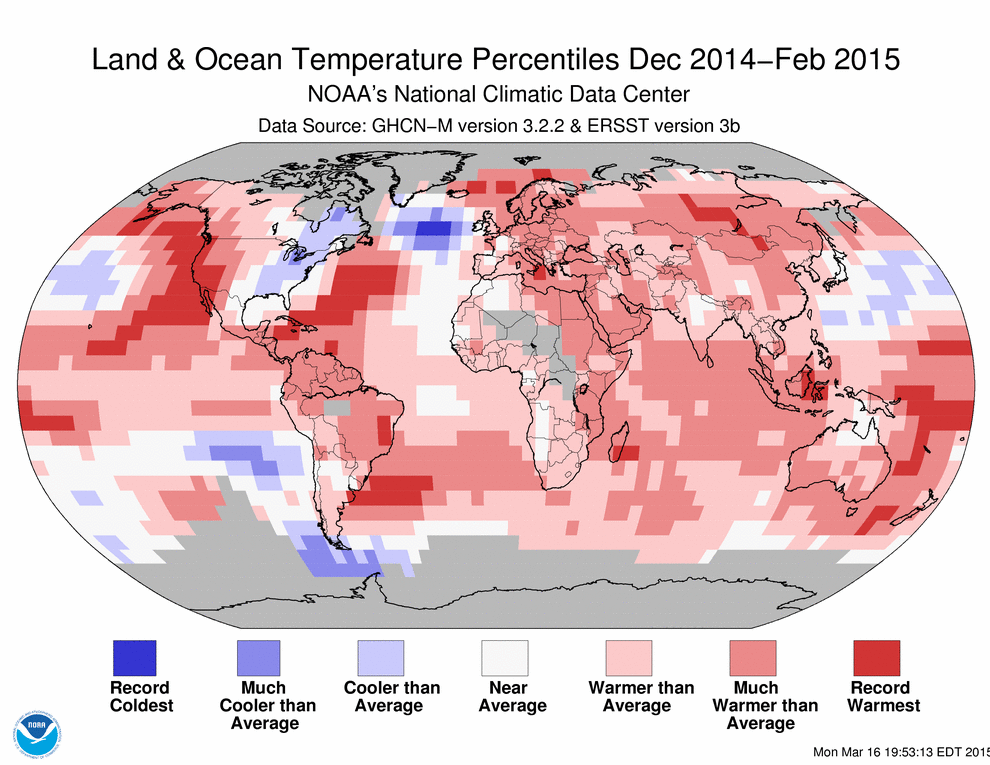
came out — and when a NOAA temperature chart for December 2014 through
February 2015 also showed record cold in this area. As Rahmstorf wrote back then,
“The North Atlantic between Newfoundland and Ireland is practically the
only region of the world that has defied global warming and even
cooled.” Since then, the trend appears to have only continued.
So
in sum, if Mann and Rahmstorf are right, a slowing of Atlantic Ocean
circulation could be beginning, and even leaving a temperature signature
for all to see.
This won’t lead to anything remotely like The Day After Tomorrow (which
was indeed based — quite loosely — on precisely this climate scenario).
But if the trend continues, there could be many consequences,
including rising seas for the U.S. East Coast and, possibly, a difference in temperature overall in the North Atlantic and Europe.
So on future climate maps, even as we rack up more hot months and years, we’d better watch the North Atlantic closely.
How climate change is affecting Greenland
View Photos
New weather patterns and melting ice bring new opportunities for the world’s largest island.
Last
week, Mrs. Clinton’s strategists acknowledged missteps . . . and
promised that this fall the public would see the sides of Mrs. Clinton
that are often obscured by the noise and distractions of modern
campaigning. They want to show her humor.
—The Times.
Clinton campaign H.Q., Brooklyn. Hillary Clinton sits with several staffers.
STAFFER 1: Here’s something. Lots of jokes start with the line “A guy walks into a barn.”
CLINTON: I like that. That’s funny.
STAFFER 2: Bar. I think it’s “A guy walks into a bar.”
CLINTON: Bar? Why is that funny? Are bars funny?
STAFFER 3: I thought it was barn, too.
STAFFER 4: What if a guy walks into a barn and sees a bar?
CLINTON: That makes no sense.
STAFFER 2: Is that funny, though? Walking into a barn?
CLINTON:
Barns are hilarious. It depends on the barn, of course, as well as the
time of year. Barns can also be sad. I’ve walked into barns in the
heartland of this great country, where jobs have vanished and the
American dream is dead.
(Long silence.)
STAFFER 1 (Googling): It’s “bar.” Oops.
CLINTON: Let’s go with “bar.”
STAFFER 3: Doesn’t something usually come after that first line, though? Like, the . . . what’s it called . . . the punch?
STAFFER 1 (Googling): Punch line.
CLINTON: O.K. Well, let’s go with “A guy walks into a bar. Punch line.” That’s funny.
STAFFER 3: No, no. I think we need a punch line. We don’t say “punch line.”
CLINTON: I’m lost.
STAFFER 1: Same here.
CLINTON:
A man is walking down the street and bumps into a bar . . . a metal
bar . . . hits his head . . . he’s O.K. And I’ll tell you why he’s O.K.
He’s O.K. because we passed the most significant health-care reform in
our nation’s history. Should it have been single-payer? I think so. But
thirty million Americans who never before had health insurance now have
coverage for issues like a head contusion from walking into a bar.
(Long silence.)
STAFFER 3: I don’t think it’s a guy walking into a metal bar.
CLINTON: What?
STAFFER 3: I think it’s a man walking into a bar that serves alcohol.
CLINTON: I don’t get it.
STAFFER 2: Is there a metal bar in this alcohol bar?
STAFFER 3: I don’t think there’s a metal bar anywhere in the story. It’s just a bar.
CLINTON: So I just say, “A man walks into an alcohol-serving bar”?
STAFFER 1: I worry that it’s going to seem like she’s urging people to drink.
STAFFER 2: Agreed. I think we had something really strong with the barn.
STAFFER 3: Maybe add a punch line?
CLINTON: Right. Let’s circle back to that. What is it, exactly?
STAFFER 3: I think it could be any number of things. Like wordplay.
STAFFER 1: I know: “A guy walks into an alcohol bar and has a club soda.”
CLINTON: Interesting.
STAFFER 3: I think it’s more, like, “A horse walks into a bar, and the bartender says, ‘Why the long face?’ ”
STAFFER 1: Sorry, I’m really confused.
STAFFER 2: Why is the bartender speaking to the horse?
CLINTON:
People. There are 9.2 million horses in America, according to the Horse
Council’s latest study on the U.S. horse industry. More than seventy
per cent of horse owners live in communities of fewer than fifty
thousand people. Let’s help horse owners protect what may be the
quintessential American animal. And let’s not let bartenders—or
anyone—demean the shape of their faces.
(Silence.)
CLINTON: So far, we have a guy walking into a bar. It’s funny. But it could be funnier. C’mon, guys. Be funny.
STAFFER 1: Does it have to be a guy walking into a bar? Could it be a woman?
STAFFER 2: A transgender woman?
STAFFER 1: We need to speak to that demographic.
STAFFER 3: Maybe it’s a woman. She sees her friends, and they say, “Hey, Steve!” And she says, “It’s Stephanie now.”
STAFFER 1: That’s beautiful.
STAFFER 4: But, is it funny?
CLINTON: There’s nothing funny about discrimination. I will fight for the rights of L.G.B.T.Q. people everywhere.
(Silence.)
STAFFER 1: What if the guy—
STAFFER 2: I’m sorry, but I really think we should be careful with pronouns.
STAFFER
1: My bad. What if the individual walking into the bar—and this gets
back to the idea of a punch line which we spoke about earlier—what if
the individual sees Roseanne Barr?
STAFFER 2: Funny. Because of the bar thing. It’s almost a homonym, I think.
STAFFER 1: What if he or she sees Barbara Bush, whom people call Bar?
CLINTON: Why is Barbara Bush sitting alone in an alcohol bar?
STAFFER 2: Are we sending the wrong signal about a revered former First Lady?
STAFFER 1: What if she’s sitting with Roseanne, and they’re drinking coffee?
STAFFER 2: And praying.
STAFFER 3: Is praying funny, though?
STAFFER 2: There was that funny Jim Carrey movie “Bruce Almighty.”
CLINTON: I like it. Get Jim Carrey.
STAFFER 1: Maybe it’s an A.A. meeting, and Roseanne fell off the wagon. Maybe Barbara Bush is leading a prayer.
CLINTON: With Jim Carrey.
STAFFER
1: Yes. And maybe the bar is filled with recovering alcoholics.
Immigrants. Mexicans. Everyone is Mexican, except Barbara Bush and
Roseanne Barr and Jim Carrey.
CLINTON: And I walk in and pour them coffee and say, “Let’s stop building walls. Let’s start building compassion.”
President Obama told a conference of world leaders at the United
Nations that Muslims should never be targeted as perpetrators of
violent extremism simply because of their faith.
“Remember that violent extremism is not unique to any one faith,” he
said, “So no one should be profiled or targeted simply because of their
faith.”
Obama made his remarks during the UN Summit on Countering ISIL and Violent Extremism held in New York City today.
Obama acknowledged, however, that Muslim youth were specifically
being targeted and recruited by ISIS, especially those who were
“disillusioned, confused, or wrestling with their own identities.”
He argued that people of all faiths and all world leaders should work
together to counter radicalization of disaffected people within
communities.
“It is up to all of us,” he said. “We have to commit ourselves to
build diverse, tolerant, inclusive, societies that reject anti-Muslim
and anti-immigrant bigotry that creates the divisions, the fear, and the
resentments upon which extremists can prey.”
Obama also called for economic prosperity in the Middle East, saying
poverty was a key component of the ISIS radicalization efforts.
While promoting military efforts that the United States was using to
degrade ISIS, Obama said it wasn’t enough to defeat the organization on
the battled field.
“Ideologies are not defeated with guns,” Obama claimed, referring to ISIS. “They are defeated by better ideas.”
The
battle over Agenda 21 is raging across the nation. City and County Councils
have become war zones as citizens question the origins of development
plans and planners deny any international connections to the UN’s
Agenda 21. What is the truth? Since I helped start this war, I believe
it is up to me to help with the answers.
The
standard points made by those who deny any Agenda 21 connection is that:
•
Local planning is a local idea. • Agenda 21 is a non-binding resolution not a
treaty, carries no legal authority from which any nation is bound to
act. It has no teeth. • The UN has no enforcement capability. • There are no “Blue-Helmeted” UN
troops at City Hall. • Planners are simply honest professionals trying
to do their job, and all these protests are wasting their valuable time.
• The main concern of Agenda 21 is that man is
fouling the environment and using up resources for future generations
and we just need a sensible plan to preserve and protect the earth.
What is so bad about that? • There is no hidden agenda. • “I’ve read Agenda 21 and I can
find no threatening language that says it is a global plot. What are
you so afraid of?” • And of course, the most often heard response
– “Agenda 21, what’s that?” • And after they have proudly stated these well
thought out points, they arrogantly throw down the gauntlet and challenge
us to “answer these facts.” • Well, first I have a few questions of my own
that I would love to have answered.
Will
one of these “innocent” promoters of the “Agenda 21
is meaningless” party line, please answer the following:
If
it all means nothing, why does the UN spend millions of dollars to hold
massive international meetings in which hundreds of leaders, potentates
and high priests attend, along with thousands of non-governmental organizations
of every description, plus the international news media, which reports
every action in breathless anticipation of its impact on the world?
It
if all means nothing, why do those same NGO representatives (which are
all officially sanctioned by the UN in order to participate) spend months
(sometimes years) debating, discussing, compiling, and drafting policy
documents?
If
it all means nothing, why do leaders representing nearly every nation
in the world attend and, with great fanfare, sign these policy documents?
Time
after time we witness these massive international meetings, we read
the documents that result from them, and when we question their meaning
or possible impact on our nation, we are met with a dismissive shrug
and a comment of “oh, probably not much…”
Really?
Then why? Why the waste of money, time, and human energy? Could it be
that the only purpose is to simply give diplomats, bureaucrats, and
NGOs a feeling of purpose in their meaningless lives, or perhaps a chance
to branch out of their lonely apartments? Or could it really be that
these meetings and the documents they produce are exactly as we say
they are – a blueprint for policy, rules, regulations, perhaps
even global governance that will affect the lives, fortunes, property
and futures of every person on earth? Which is it? You can’t have
it both ways.
Why
the fear of Agenda 21?
Those
who simply read or quickly scan Agenda 21 are puzzled by our opposition
to what they see as a harmless, non-controversial document which they
read as voluntary suggestions for preserving natural resources and protecting
the environment. Why the fear? What exactly bothers us so much?
The
problem is, we who oppose Agenda 21 have read and studied much more
than this one document and we’ve connected the dots. Many of us
have attended those international meetings, rubbed elbows with the authors
and leaders of the advocated policies, and overheard their insider (not
for public distribution) comments about their real purpose.
Here
are a few examples of those comments made by major leaders of this movement
as to the true purpose of the policies coming out of these UN meetings:
“No
matter if the science of global warming is all phony…climate change
provides the greatest opportunity to bring about justice and equality
in the world.”
Christine
Stewart (former Canadian Minister of the Environment)
“The
concept of national sovereignty has been immutable, indeed a sacred
principle of international relations. It is a principle which will yield
only slowly and reluctantly to the new imperatives of global environmental
cooperation.” Report from the UN Commission on Global Governance.
“Regionalism
must precede globalism. We foresee a seamless system of governance from
local communities, individual states, regional unions and up through
to the United Nations itself.” Report from the UN Commission on
Global Governance.
All
three of these quotes (and we have many) indicate using lies and rhetoric
to achieve their goals, and that those goals include the elimination
of national sovereignty and the creation of a “seamless system”
for global governance. Again, do these quotes have meaning and purpose
– do they reveal the true thoughts of the promoters of these policies,
or were they just joking?
For
the past three decades through the United Nations infrastructure, there
have been a series of meetings, each producing another document or lynchpin
to lay the groundwork for a centralized global economy, judicial system,
military, and communications system, leading to what can only be described
as a global government. From our study of these events, we have come
to the conclusion that Agenda 21 represents the culmination of all of
those efforts, indeed representing the step by step blueprint for the
full imposition of those goals. Here’s just a sample of these
meetings and the documents they produced:
In
1980, West German Chancellor Willy Brandt chaired the Commission on
International Development. The document, or report coming out of this
effort, entitled “North-South: A program for Survival,”
stated “World development is not merely an economic process, [it]
involves a profound transformation of the entire economic and social
structure…not only the idea of economic betterment, but also of
greater human dignity, security, justice and equality…The Commission
realizes that mankind has to develop a concept of a ‘single community’
to develop global order.”
That
same year Sean MacBride, a recipient of the Lenin Peace Prize, headed
up a commission on international communications which issued a report
entitled “Many Voices, One World: Towards a New, More Just and
More Efficient World Information and Communication Order.” The
Commission, which included the head of the Soviet news Agency, TASS,
believed that a “New World Information Order” was prerequisite
to a new world economic order. The report was a blueprint for controlling
the media, even to the point of suggesting that international journalists
be licensed.
In
1982, Olof Palme, the man who single-handedly returned Socialism to
Sweden, served as chairman of the Independent Commission on Disarmament
and Security Issues. His report, entitled “Common Security: A
Blueprint for Survival,” said: “All States have the duty
to promote the achievement of general and complete disarmament under
effective international control…” The report went on to
call for money that is saved from disarmament to be used to pay for
social programs. The Commission also proposed a strategic shift from
“collective security” such as the alliances like NATO, to
one of “common security” through the United Nations.
Finally,
in 1987, came the granddaddy commission of them all, The Brundtland
Commission on Environment and Development. Headed by Gro Harlem Brundtland,
Vice President of the World Socialist Party, the commission introduced
the concept of “Sustainable
Development.” For the first time the environment was tied
to the tried and true Socialist goals of international redistribution
of wealth. Said the report, “Poverty is a major cause and effect
of global environmental problems. It is therefore futile to attempt
to deal with environmental problems without a broader perspective that
encompasses the factors underlying world poverty and international inequality.”
These
four commissions laid the groundwork for an agenda of global control;
A controlled media would dictate the flow of information and ideas and
prevent dissent; control of international development manages and redistributes
wealth; full disarmament would put the power structure into the hands
of those with armaments; and tying environmentalism to poverty and economic
development would bring the entire agenda to the level of an international
emergency.
One
world, one media, one authority for development, one source of wealth,
one international army. The construction of a “just society”
with political and social equality rather than a free society with the
individual as the sole possessor of rights. The next step was to pull
it altogether into a simple blueprint for implementation.
During
the 1990s, the UN sponsored a series of summits and conferences dealing
with such issues as human rights, the rights of the child, forced abortion
and sterilization as solutions for population control, and plans for
global taxation through the UN.
Throughout
each of these summits, hundreds of Non-governmental organizations (NGOs)
worked behind the scenes to write policy documents pertaining to each
of these issues, detailing goals and a process to achieve them. These
NGO’s are specifically sanctioned by the United Nations in order
to participate in the process. The UN views them as “civil society,
the non governmental representatives of the people. In short, in the
eyes of the UN, the NGOs are the “people.”
Who
are they? They include activist groups with private political agendas
including the Environmental Defense Fund, National Audubon Society,
The Nature Conservancy, National Wildlife Federation, Zero Population
Growth, Planned Parenthood, the Sierra Club, the National Education
Association, an d hundreds more. These groups all have specific political
agendas which they desire to become law of the land. Through work in
these international summits and conferences, their political wish lists
become official government policy.
In
fact, through the UN infrastructure the NGOs sit in equality to government
officials from member nations including the United States. One of the
most powerful UN operations is the United Nations Environmental Program
(UNEP). Created in 1973 by the UN General Assembly, the UNEP is the
catalyst through which the global environmental agenda is implemented.
Virtually all international environmental programs and policy changes
that have occurred globally in the past three decades are a result of
UNEP efforts. Sitting in on UNEP meetings, helping to write and implement
policy, along with these powerful NGOs are government representatives,
including U.S, federal agencies such as the Department of State, Department
of Interior, Department of Agriculture, Environmental Protection Agency,
the National Park Service, the U.S. Forest Service, and the Fish and
Wildlife Service.
This,
then, is a glimpse of the power structure behind the force that gathered
in Rio de Janeiro in 1992 for the UN-sponsored Earth Summit. Here, five
major documents, written primarily by NGOs with the guidance and assistance
of government agencies, were introduced to the world. In fact, these
final documents had been first drafted and honed though the long, arduous
series of international conferences previously mentioned. Now, at Rio,
they were ready for adoption as a blueprint for what could only be described
as the transformation of human society. For part two click below.
AGENDA
21 CONSPIRACY THEORY OR THREAT PART 2 of 2
by
Tom DeWeese
May 21, 2012 NewsWithViews.com
The
five documents were: the “Convention on Climate Change,”
the precursor to the coming Kyoto Climate Change Protocol, later adopted
in 1997; the “Biodiversity Treaty,” which would declare
that massive amounts of land should be off limits to human development;
the third document was called the “Rio Declaration,” which
called for the eradication of poverty throughout the world through the
redistribution of wealth; the fourth document was the “Convention
on Forest Principles,” calling for international management of
the world’s forests, essentially shutting down or severely regulating
the timber industry; and the fifth document was Agenda 21, which contained
the full agenda for implementing worldwide Sustainable Development.
The 300 page document contains 40 chapters that address virtually every
facet of human life and contains great detail as to how the concept
of Sustainable Development should be implemented through every level
of government.
What
did the United Nations believe that process entailed? In 1993, to help
explain the far-reaching aspects of the plan, the UN published “Agenda
21: The Earth Summit Strategy to Save Our Planet.” Here’s
how the UN described Agenda 21 in that document: “Agenda 21 proposes
an array of actions which are intended to be implemented by every person
on earth…it calls for specific changes in the activities of all
people…Effective execution of Agenda 21 will require a profound
reorientation of all humans, unlike anything the world has ever experienced.”
I have never read a stronger, more powerful description of the use of
government power.
However,
critics of our efforts against Agenda 21 rush to point out that Agenda
21 is a “soft law” policy – not a treaty that must
be ratified by the U.S. Senate to become law. So it is just a suggestion,
nothing to be afraid of. To make such an argument means that these critics
have failed to follow the bouncing ball of implementation.
Following
the bouncing ball to implementation
It
started when, at the Earth Summit, President George H.W. Bush, along
with 179 other heads of state signed agreement to Agenda 21. One year
later, newly elected President Bill Clinton signed Executive Order #
12852 to create the President’s Council on Sustainable Development
(PCSD). The Council consisted of 12 cabinet secretaries, top executives
from business, and executives from six major environmental organizations,
including the Nature Conservancy, The Sierra Club, the World Resources
Institute, and the National Wildlife Federation. These were all players
in the creation of Agenda 21 at the international level – now
openly serving on the PCSD with the specific mission to implement Agenda
21 into American policy.
It
is interesting to note that in the pages of the PCSD report entitled
“Sustainable America: A new Consensus for the Future, it directly
quotes the Brundtland Commission’s report “Our Common Future”
for a definition of Sustainable Development. That is about as direct
a tie to the UN as one can get. The PCSD brought the concept of Sustainable
Development into the policy process of every agencies of the US federal
government
A
major tool for implementation was the enormous grant-making power of
the federal government. Grant programs were created through literally
every agency to entice states and local communities to accept Sustainable
Development policy in local programs. In fact, the green groups
serving on the PCSD, which also wrote Agenda 21 in the first place,
knew full well what programs needed to be implemented to enforce Sustainable
Development policy, and they helped create the grant programs, complete
with specific actions that must be taken by communities to assure the
money is properly spent to implement Sustainable Development policy.
Those are the “strings” to which we opponents refer. Such
tactics make the grants effective weapons to insure the policy is moving
forward.
From
that point, these same NGOs sent their members into the state legislatures
to lobby for and encourage policy and additional state grant programs.
They have lobbied for states to produce legislation requiring local
communities to implement comprehensive development plans. Once that
legislation was in place, the same NGOs (authors of Agenda 21) quickly
moved into the local communities to “help” local governments
comply with the state mandates. And they pledged to help by showing
communities how to acquire the grant money to pay for it – with
the above mentioned strings attached.
We’re
told over and over again that such policies are local, state and national,
with no conspiracy of ties to the UN. Really? Then how are we to explain
this message, taken from the Federal Register, August 24, 1998, (Volume
63, Number 163) from a discussion on the EPA Sustainable Development
Challenge Grant Program? It says, “The Sustainable
Development Challenge Grant Program is also a step in Implementing
‘Agenda 21, the Global Plan of Action on Sustainable Development,’
signed by the United Stats at the Earth Summit in Rio de Janeiro in
1992. All of these programs require broad community participation to
identify and address environmental issues.”
Or
consider this quote from a report by Phil Janik, Chief Operating Officer
of the USDA – Forest Service, entitled “The USDA-Forest
Service Commitment and Approach to Forest Sustainability” “In
Our Common Future published in 1987, the Brundtland Commission explains
that ‘the environment is where we all live; and development is
what we all do in attempting to improve our lot within that abode.”
In short, Janik was explaining to his audience (the Society of American
Foresters) just where the Forest Service was getting its definition
of Sustainable Development – the report from the UN Commission
on Global Governance.
Meanwhile,
the NGOs began to “partner” with other governmental organizations
like the U.S. Conference of Mayors, the National Governors Association,
the National League of Cities, the National Association of County Administrators
and more organizations to which elected representatives belong to, assuring
a near that a near universal message of Sustainable Development comes
from every level of government.
Another
NGO group which helped write Agenda 21 for the UN Earth Summit was a
group originally called the International Council for Local Environmental
Initiatives (ICLEI). It now calls itself ICLEI – Local Governments
for Sustainability. After the Earth Summit in 1992, ICLEI set its mission
to move into the policy process of local governments around the world
to impose Sustainable Development policy. It now operates in more than
1200 cities globally, including 600 American cities, all of which pay
dues for the privilege of working with ICLEI. Like a cancer, ICLEI begins
to infest the local government policy, training city employees to think
only in terms of Sustainable Development, and replacing local guidelines
with international codes, rules and regulations.
So
it’s true, there are no UN blue helmeted troops occupying city
halls in America, and yes, the UN itself does not have enforcement capability
for this “:non-binding” document called Agenda 21. However,
it does have its own storm troopers in the person of the Non-governmental
Organizations which the UN officially sanctions to carry on its work.
And that is how Agenda 21, a UN policy, has become a direct threat to
local American communities.
Why
we oppose Agenda 21
It’s
important to note that we fight Agenda 21 because we oppose its policies
and its process, not just its origins. Why do we see it as a threat?
Isn’t it just a plan to protect the environment and stop uncontrolled
development and sprawl?
As
Henry Lamb of Freedom 21 puts it, “Comprehensive land use planning
that delivers sustainable development to local communities transforms
both the process through which decisions that govern citizens are made,
and the market place where citizens must earn their livelihood. The
fundamental principle that government is empowered by the consent of
the governed is completely by-passed in the process…the natural
next step is for government to dictate the behavior of the people who
own the land that the government controls.”
To
enforce the policy, local government is being transformed by “stakeholder
councils” created and enforced by the same NGO Agenda 21 authors.
They are busy creating a matrix of non-elected boards, councils and
regional governments that usurp the ability of citizens to have an impact
on policy. It’s the demise of representative government. And the
councils appear and grow almost overnight.
Sustainablists
involve themselves in every aspect of society. Here are just a few of
the programs and issues that can be found in the Agenda 21 blueprint
and can be easily found in nearly every community’s “local”
development plans: Wetlands, conservation easements, water sheds, view
sheds, rails – to- trails, biosphere reserves, greenways, carbon
footprints, partnerships, preservation, stakeholders, land use, environmental
protection, development, diversity, visioning, open space, heritage
areas and comprehensive planning. Every one of these programs leads
to more government control, land grabs and restrictions on energy, water,
and our own property. When we hear these terms we know that such policy
originated on the pages of Agenda 21, regardless of the direct or indirect
path it took to get to our community.
You’ll
find Watershed Councils that regulate human action near every trickling
stream, river, or lake. Meters are put on wells. Special “action”
councils control home size, tree pruning, or removal, even the color
you can paint your home or the height of your grass. Historic preservation
councils control development in downtown areas, disallowing expansion
and new building.
Regional
governments are driven by NGOs and stakeholder councils with a few co-opted
bureaucrats thrown in to look good. These are run by non-elected councils
that don’t answer to the people. In short, elected officials become
little more than a rubber stamp to provide official “approval”
to the regional bureaucracy.
But
the agenda outlined in Agenda 21 and by its proponents is a much bigger
threat that just land use planning. They openly advocate massive reduction
of human populations. Some actually call for as much as an 85% reduction
in human populations in order to “save the planet.” David
Brower of the Sierra Club said, “Childbearing should be a punishable
crime against society, unless the parents hold a government license.”
The UN’s Biodiversity Assessment says, “A reasonable estimate
for an industrialized world society at the present North American material
standard of living would be 1 billion.”
They
also openly advocate the destruction of modern society as Maurice Strong,
the head of the Earth Summit said, “Isn’t the only hope
for the planet that the industrial nations collapse? Isn’t it
our responsibility to bring that about?
This
issue then is not about simple environmental protection and modern planning.
It is about a complete restructuring of our society, our values and
our way of life. They use as their model an urgency based on global
warming and climate change, claiming there is no need for discussion
on these dire issues. Yet science is showing more and more proof that
there is no man-made global warming. Are we to completely destroy our
society based on such a shaky foundation?
And
that is just what the proponents are rushing to do.
Barack
Obama has issued a flurry of Executive Orders to bypass the Congressional
process and dictate sustainable policy. In 2011 Obama issued EO # 13575
creating the White House Rural Council. It brings together 25 Cabinet
Secretaries to enforce multi-jurisdictional enforcement of farming virtually
controlling every decision for food production. It is a major assault
on American farm production intended to enforce Sustainable farming
practices. In truth it will only lead to food shortages and higher prices
as farmers have no ability to make a decision without the approval of
25 government agencies, working at cross purposes and causing chaos
in farm production.
On
May1, 2012, Obama issued EO # 13609, dictating that the government must
enforce coordination of international regulatory policy. Those international
regulatory policies are UN-driven and the basic translation means enforcement
of Sustainable Development policy.
But,
again, skeptics of our fears of Agenda 21 continue to argue that it
is all voluntary and if the US or local governments want to enforce
it they are free to do so – nothing to fear but ourselves. Well,
even if that were true, that’s all about to change. On June 15
– 23, international forces are again converging on Rio for Rio+20.
The stated intention is to complete the work they began in 1992.
Specifically
called for is a UN treaty on Sustainable Development. If passed by the
Senate and signed by the Obama Administration, that will eliminate any
ambiguity about where the policy is coming from. Moreover, documents
produced so far for the summit call for a global council, new UN agencies,
budgets and powers, and “genuine global actions” in every
nation – to ensure “social justice,” poverty eradication,
climate protection, biodiversity, “green growth,” and an
end to “unsustainable patterns of consumption.” Again, thousands
of NGOs, diplomats and world leaders will spend a lot of money and time
in the Rio+20 effort. Is it all just for fun, or does it have a purpose
with strong consequences for our way of life?
The
fact is, we fight Agenda 21 because it is all-encompassing, designed
to address literally every aspect of our lives. This is so because those
promoting Agenda 21 believe we must modify our behavior, our way of
doing everyday things, and even our belief system, in order to drastically
transform human society into being “sustainable.”
We
who oppose it don’t believe that the world is in such dire emergency
environmentally that we must destroy the very human civilization that
brought us from a life of nothing but survival against the elements
into a world that gave us homes, health care, food, and even luxury.
Sustainable Development advocates literally hope to roll back our civilization
to the days of mere survival and we say NO. Why should we? We have found
great deception in the promotion of the global warming argument.
We
believe in free markets and free societies where people make their own
decisions, live and develop their own property. And we fully believe
that the true path to a strong protection of the environment is through
private property ownership and limited government. Those who promote
Agenda 21 do not believe in those ideals. And so we will not agree on
the path to the future. And our fight is just that – a clash of
philosophy. There is very little room for middle ground.
The
United States has never been part of a global village in which rules
for life have been handed down by some self-appointed village elders.
We are a nation of laws that were designed to protect our right to our
property and our individual life choices while keeping government reined
in. We oppose Agenda 21 precisely because it represents the exact opposite
view of government. For part one click below.
When anyone tries to inform another person what Agenda 21 is and
how it is a really bad thing coming “down the pipe from the U.N.” right
into their very own back yard Council, they usually get a strange look
of either bewilderment or downright dismissal as if that person is a
lunatic!
Agenda 21 has been intentionally written in such a way that one’s
eyes usually begin to “glaze over” after only the first few pages of
words that sound like an alien race had written them and seem
“almost understandable” but not quite!
This document is actually the “blueprint” for a Global Government to
replace every freely elected individual and Government in the World!
Read the following and you will “understand” why people are both
scared of the Agenda 21 declarations and mad as hell that an
organization as big as the United Nations would even attempt to put
something like this into action!
Get informed before it’s too late!
Tom Deweese Thursday, May 17, 2012Canada Free Press
The battle over Agenda 21 is raging across the
nation. City and County Councils have become war zones as citizens
question the origins of development plans and planners deny any
international connections to the UN’s Agenda 21. What is the truth?
Since I helped start this war, I believe it is up to me to help with the
answers. Local planning is a local idea.The standard points made by those who deny any Agenda 21 connection is that:
Agenda 21 is a non-binding resolution not a treaty, carries no legal
authority from which any nation is bound to act. It has no teeth.
The UN has no enforcement capability.
There are no “Blue-Helmeted” UN troops at City Hall.
Planners are simply honest professionals trying to do their job, and all these protests are wasting their valuable time.
The main concern of Agenda 21 is that man is fouling the environment
and using up resources for future generations and we just need a
sensible plan to preserve and protect the earth. What is so bad about
that?
There is no hidden agenda.
“I’ve read Agenda 21 and I can find no threatening language that says it is a global plot. What are you so afraid of?”
And of course, the most often heard response – “Agenda 21, what’s that?”
And after they have proudly stated these well thought out points,
they arrogantly throw down the gauntlet and challenge us to “answer
these facts.”
Will one of these “innocent” promoters of the “Agenda 21 is
meaningless” party line, please answer the following: Well, first I have
a few questions of my own that I would love to have answered.
If it all means nothing, why does the UN spend millions of dollars to
hold massive international meetings in which hundreds of leaders,
potentates and high priests attend, along with thousands of
non-governmental organizations of every description, plus the
international news media, which reports every action in breathless
anticipation of its impact on the world?
It if all means nothing, why do those same NGO representatives (which
are all officially sanctioned by the UN in order to participate) spend
months (sometimes years) debating, discussing, compiling, and drafting
policy documents?
If it all means nothing, why do leaders representing nearly every
nation in the world attend and, with great fanfare, sign these policy
documents?
Time after time we witness these massive international meetings, we
read the documents that result from them, and when we question their
meaning or possible impact on our nation, we are met with a dismissive
shrug and a comment of “oh, probably not much…”
Really? Then why? Why the waste of money, time, and human energy?
Could it be that the only purpose is to simply give diplomats,
bureaucrats, and NGOs a feeling of purpose in their meaningless lives,
or perhaps a chance to branch out of their lonely apartments? Or could
it really be that these meetings and the documents they produce are
exactly as we say they are – a blueprint for policy, rules,
regulations, perhaps even global governance that will affect the lives,
fortunes, property and futures of every person on earth? Which is it? You can’t have it both ways.
Why the fear of Agenda 21?
Those who simply read or quickly scan Agenda 21 are puzzled by our
opposition to what they see as a harmless, non-controversial document
which they read as voluntary suggestions for preserving natural
resources and protecting the environment. Why the fear? What exactly
bothers us so much?
The problem is, we who oppose Agenda 21 have read and studied much
more than this one document and we’ve connected the dots. Many of us
have attended those international meetings, rubbed elbows with the
authors and leaders of the advocated policies, and overheard their
insider (not for public distribution) comments about their real purpose.
Here are a few examples of those comments made by major leaders of
this movement as to the true purpose of the policies coming out of these
UN meetings:
“No matter if the science of global warming is all phony…climate
change provides the greatest opportunity to bring about justice and
equality in the world.”
Christine Stewart (former Canadian Minister of the Environment)
“The concept of national sovereignty has been immutable, indeed a
sacred principle of international relations. It is a principle which
will yield only slowly and reluctantly to the new imperatives of global
environmental cooperation.” Report from the UN Commission on Global
Governance.
“Regionalism must precede globalism. We foresee a seamless system of
governance from local communities, individual states, regional unions
and up through to the United Nations itself.” Report from the UN
Commission on Global Governance.
All three of these quotes (and we have many) indicate using lies and
rhetoric to achieve their goals, and that those goals include the
elimination of national sovereignty and the creation of a “seamless
system” for global governance. Again, do these quotes have meaning and
purpose – do they reveal the true thoughts of the promoters of these
policies, or were they just joking?
For the past three decades through the United Nations infrastructure,
there have been a series of meetings, each producing another document
or lynchpin to lay the groundwork for a centralized global economy,
judicial system, military, and communications system, leading to what
can only be described as a global government. From our study of these
events, we have come to the conclusion that Agenda 21 represents the
culmination of all of those efforts, indeed representing the step by
step blueprint for the full imposition of those goals. Here’s just a
sample of these meetings and the documents they produced:
In 1980, West German Chancellor Willy Brandt chaired the Commission
on International Development. The document, or report coming out of this
effort, entitled “North-South: A program for Survival,” stated “World
development is not merely an economic process, [it] involves a profound
transformation of the entire economic and social structure…not only the
idea of economic betterment, but also of greater human dignity,
security, justice and equality…The Commission realizes that mankind has
to develop a concept of a ‘single community’ to develop global order.”
That same year Sean MacBride, a recipient of the Lenin Peace Prize,
headed up a commission on international communications which issued a
report entitled “Many Voices, One World: Towards a New, More Just and
More Efficient World Information and Communication Order.” The
Commission, which included the head of the Soviet news Agency, TASS,
believed that a “New World Information Order” was prerequisite to a new
world economic order. The report was a blueprint for controlling the
media, even to the point of suggesting that international journalists be
licensed.
In 1982, Olof Palme, the man who single-handedly returned Socialism
to Sweden, served as chairman of the Independent Commission on
Disarmament and Security Issues. His report, entitled “Common Security: A
Blueprint for Survival,” said: “All States have the duty to promote the
achievement of general and complete disarmament under effective
international control…” The report went on to call for money that is
saved from disarmament to be used to pay for social programs. The
Commission also proposed a strategic shift from “collective security”
such as the alliances like NATO, to one of “common security” through the
United Nations.
Finally, in 1987, came the granddaddy commission of them all, The
Brundtland Commission on Environment and Development. Headed by Gro
Harlem Brundtland, Vice President of the World Socialist Party, the
commission introduced the concept of “Sustainable Development.”
For the first time the environment was tied to the tried and true
Socialist goals of international redistribution of wealth. Said the
report, “Poverty is a major cause and effect of global environmental
problems. It is therefore futile to attempt to deal with environmental
problems without a broader perspective that encompasses the factors
underlying world poverty and international inequality.”
These four commissions laid the groundwork for an agenda of global
control; A controlled media would dictate the flow of information and
ideas and prevent dissent; control of international development manages
and redistributes wealth; full disarmament would put the power structure
into the hands of those with armaments; and tying environmentalism to
poverty and economic development would bring the entire agenda to the
level of an international emergency.
One world, one media, one authority for development, one source of
wealth, one international army. The construction of a “just society”
with political and social equality rather than a free society with the
individual as the sole possessor of rights. The next step was to pull it
altogether into a simple blueprint for implementation.
During the 1990s, the UN sponsored a series of summits and
conferences dealing with such issues as human rights, the rights of the
child, forced abortion and sterilization as solutions for population
control, and plans for global taxation through the UN.
Throughout each of these summits, hundreds of Non-governmental
organizations (NGOs) worked behind the scenes to write policy documents
pertaining to each of these issues, detailing goals and a process to
achieve them. These NGO’s are specifically sanctioned by the United
Nations in order to participate in the process. The UN views them as
“civil society, the non governmental representatives of the people. In
short, in the eyes of the UN, the NGOs are the “people.”
Who are they? They include activist groups with private political
agendas including the Environmental Defense Fund, National Audubon
Society, The Nature Conservancy, National Wildlife Federation, Zero
Population Growth, Planned Parenthood, the Sierra Club, the National
Education Association, an d hundreds more. These groups all have
specific political agendas which they desire to become law of the land.
Through work in these international summits and conferences, their
political wish lists become official government policy.
In fact, through the UN infrastructure the NGOs sit in equality to
government officials from member nations including the United States.
One of the most powerful UN operations is the United Nations
Environmental Program (UNEP). Created in 1973 by the UN General
Assembly, the UNEP is the catalyst through which the global
environmental agenda is implemented. Virtually all international
environmental programs and policy changes that have occurred globally in
the past three decades are a result of UNEP efforts. Sitting in on UNEP
meetings, helping to write and implement policy, along with these
powerful NGOs are government representatives, including U.S, federal
agencies such as the Department of State, Department of Interior,
Department of Agriculture, Environmental Protection Agency, the National
Park Service, the U.S. Forest Service, and the Fish and Wildlife
Service.
This, then, is a glimpse of the power structure behind the force that
gathered in Rio de Janeiro in 1992 for the UN-sponsored Earth Summit.
Here, five major documents, written primarily by NGOs with the guidance
and assistance of government agencies, were introduced to the world. In
fact, these final documents had been first drafted and honed though the
long, arduous series of international conferences previously mentioned.
Now, at Rio, they were ready for adoption as a blueprint for what could
only be described as the transformation of human society.
The five documents were: the “Convention on Climate Change,” the
precursor to the coming Kyoto Climate Change Protocol, later adopted in
1997; the “Biodiversity Treaty,” which would declare that massive
amounts of land should be off limits to human development; the third
document was called the “Rio Declaration,” which called for the
eradication of poverty throughout the world through the redistribution
of wealth; the fourth document was the “Convention on Forest
Principles,” calling for international management of the world’s
forests, essentially shutting down or severely regulating the timber
industry; and the fifth document was Agenda 21, which contained the full
agenda for implementing worldwide Sustainable Development. The 300 page
document contains 40 chapters that address virtually every facet of
human life and contains great detail as to how the concept of
Sustainable Development should be implemented through every level of
government.
What did the United Nations believe that process entailed? In 1993,
to help explain the far-reaching aspects of the plan, the UN published
“Agenda 21: The Earth Summit Strategy to Save Our Planet.” Here’s how
the UN described Agenda 21 in that document: “Agenda 21 proposes an
array of actions which are intended to be implemented by every person on
earth…it calls for specific changes in the activities of all
people…Effective execution of Agenda 21 will require a profound
reorientation of all humans, unlike anything the world has ever
experienced.” I have never read a stronger, more powerful description of
the use of government power.
However, critics of our efforts against Agenda 21 rush to point out
that Agenda 21 is a “soft law” policy – not a treaty that must be
ratified by the U.S. Senate to become law. So it is just a suggestion,
nothing to be afraid of. To make such an argument means that these
critics have failed to follow the bouncing ball of implementation.
Following the bouncing ball to implementation
It started when, at the Earth Summit, President George H.W. Bush,
along with 179 other heads of state signed agreement to Agenda 21. One
year later, newly elected President Bill Clinton signed Executive Order #
12852 to create the President’s Council on Sustainable Development
(PCSD). The Council consisted of 12 cabinet secretaries, top executives
from business, and executives from six major environmental
organizations, including the Nature Conservancy, The Sierra Club, the World Resources Institute, and the National Wildlife Federation.
These were all players in the creation of Agenda 21 at the
international level – now openly serving on the PCSD with the specific
mission to implement Agenda 21 into American policy.
It is interesting to note that in the pages of the PCSD report
entitled “Sustainable America: A new Consensus for the Future, it
directly quotes the Brundtland Commission’s report “Our Common Future”
for a definition of Sustainable Development. That is about as direct a
tie to the UN as one can get. The PCSD brought the concept of
Sustainable Development into the policy process of every agencies of the
US federal government
A major tool for implementation was the enormous grant-making power
of the federal government. Grant programs were created through literally
every agency to entice states and local communities to accept
Sustainable Development policy in local programs. In fact, the green
groups serving on the PCSD, which also wrote Agenda 21 in the first
place, knew full well what programs needed to be implemented to enforce
Sustainable Development policy, and they helped create the grant
programs, complete with specific actions that must be taken by
communities to assure the money is properly spent to implement
Sustainable Development policy. Those are the “strings” to which we
opponents refer. Such tactics make the grants effective weapons to
insure the policy is moving forward.
From that point, these same NGOs sent their members into the state
legislatures to lobby for and encourage policy and additional state
grant programs. They have lobbied for states to produce legislation
requiring local communities to implement comprehensive development
plans. Once that legislation was in place, the same NGOs (authors of
Agenda 21) quickly moved into the local communities to “help” local
governments comply with the state mandates. And they pledged to help by
showing communities how to acquire the grant money to pay for it – with
the above mentioned strings attached.
We’re told over and over again that such policies are local, state
and national, with no conspiracy of ties to the UN. Really? Then how are
we to explain this message, taken from the Federal Register, August 24,
1998, (Volume 63, Number 163) from a discussion on the EPA Sustainable
Development Challenge Grant Program? It says, “The Sustainable
Development Challenge Grant Program is also a step in Implementing
‘Agenda 21, the Global Plan of Action on Sustainable Development,’
signed by the United Stats at the Earth Summit in Rio de Janeiro in
1992. All of these programs require broad community participation to
identify and address environmental issues.”
Or consider this quote from a report by Phil Janik, Chief Operating
Officer of the USDA – Forest Service, entitled “The USDA-Forest Service
Commitment and Approach to Forest Sustainability” “In Our Common Future
published in 1987, the Brundtland Commission explains that ‘the
environment is where we all live; and development is what we all do in
attempting to improve our lot within that abode.” In short, Janik was
explaining to his audience (the Society of American Foresters) just
where the Forest Service was getting its definition of Sustainable
Development – the report from the UN Commission on Global Governance.
Meanwhile, the NGOs began to “partner” with other governmental
organizations like the U.S. Conference of Mayors, the National Governors
Association, the National League of Cities, the National Association of
County Administrators and more organizations to which elected
representatives belong to, assuring a near that a near universal message
of Sustainable Development comes from every level of government.
Another NGO group which helped write Agenda 21 for the UN Earth
Summit was a group originally called the International Council for Local
Environmental Initiatives (ICLEI). It now calls itself ICLEI – Local
Governments for Sustainability. After the Earth Summit in 1992, ICLEI
set its mission to move into the policy process of local governments
around the world to impose Sustainable Development policy. It now
operates in more than 1200 cities globally, including 600 American
cities, all of which pay dues for the privilege of working with ICLEI.
Like a cancer, ICLEI begins to infest the local government policy,
training city employees to think only in terms of Sustainable
Development, and replacing local guidelines with international codes,
rules and regulations.
So it’s true, there are no UN blue helmeted troops occupying city
halls in America, and yes, the UN itself does not have enforcement
capability for this “:non-binding” document called Agenda 21. However,
it does have its own storm troopers in the person of the
Non-governmental Organizations which the UN officially sanctions to
carry on its work. And that is how Agenda 21, a UN policy, has become a
direct threat to local American communities.
Why we oppose Agenda 21
It’s important to note that we fight Agenda 21 because we oppose its
policies and its process, not just its origins. Why do we see it as a
threat? Isn’t it just a plan to protect the environment and stop
uncontrolled development and sprawl?
As Henry Lamb of Freedom 21 puts it, “Comprehensive land use planning
that delivers sustainable development to local communities transforms
both the process through which decisions that govern citizens are made,
and the market place where citizens must earn their livelihood. The
fundamental principle that government is empowered by the consent of the
governed is completely by-passed in the process…the natural next step
is for government to dictate the behavior of the people who own the land
that the government controls.”
To enforce the policy, local government is being transformed by
“stakeholder councils” created and enforced by the same NGO Agenda 21
authors. They are busy creating a matrix of non-elected boards, councils
and regional governments that usurp the ability of citizens to have an
impact on policy. It’s the demise of representative government. And the
councils appear and grow almost overnight.
Sustainablists involve themselves in every aspect of society. Here
are just a few of the programs and issues that can be found in the
Agenda 21 blueprint and can be easily found in nearly every community’s
“local” development plans: Wetlands, conservation easements, water
sheds, view sheds, rails – to- trails, biosphere reserves, greenways,
carbon footprints, partnerships, preservation, stakeholders, land use,
environmental protection, development, diversity, visioning, open space,
heritage areas and comprehensive planning. Every one of these programs
leads to more government control, land grabs and restrictions on energy,
water, and our own property. When we hear these terms we know that such
policy originated on the pages of Agenda 21, regardless of the direct
or indirect path it took to get to our community.
You’ll find Watershed Councils that regulate human action near every
trickling stream, river, or lake. Meters are put on wells. Special
“action” councils control home size, tree pruning, or removal, even the
color you can paint your home or the height of your grass. Historic
preservation councils control development in downtown areas, disallowing
expansion and new building.
Regional governments are driven by NGOs and stakeholder councils with
a few co-opted bureaucrats thrown in to look good. These are run by
non-elected councils that don’t answer to the people. In short, elected
officials become little more than a rubber stamp to provide official
“approval” to the regional bureaucracy.
But the agenda outlined in Agenda 21 and by its proponents is a much
bigger threat that just land use planning. They openly advocate massive
reduction of human populations. Some actually call for as much as an 85%
reduction in human populations in order to “save the planet.” David
Brower of the Sierra Club said, “Childbearing should be a punishable
crime against society, unless the parents hold a government license.”
The UN’s Biodiversity Assessment says, “A reasonable estimate for an
industrialized world society at the present North American material
standard of living would be 1 billion.”
They also openly advocate the destruction of modern society as
Maurice Strong, the head of the Earth Summit said, “Isn’t the only hope
for the planet that the industrial nations collapse? Isn’t it our
responsibility to bring that about?
This issue then is not about simple environmental protection and
modern planning. It is about a complete restructuring of our society,
our values and our way of life. They use as their model an urgency based
on global warming and climate change, claiming there is no need for
discussion on these dire issues. Yet science is showing more and more
proof that there is no man-made global warming. Are we to completely
destroy our society based on such a shaky foundation?
And that is just what the proponents are rushing to do.
Barack Obama has issued a flurry of Executive Orders to bypass the
Congressional process and dictate sustainable policy. In 2011 Obama
issued EO # 13575 creating the White House Rural Council. It brings
together 25 Cabinet Secretaries to enforce multi-jurisdictional
enforcement of farming virtually controlling every decision for food
production. It is a major assault on American farm production intended
to enforce Sustainable farming practices. In truth it will only lead to
food shortages and higher prices as farmers have no ability to make a
decision without the approval of 25 government agencies, working at
cross purposes and causing chaos in farm production.
On May1, 2012, Obama issued EO # 13609, dictating that the government
must enforce coordination of international regulatory policy. Those
international regulatory policies are UN-driven and the basic
translation means enforcement of Sustainable Development policy.
But, again, skeptics of our fears of Agenda 21 continue to argue that
it is all voluntary and if the US or local governments want to enforce
it they are free to do so – nothing to fear but ourselves. Well, even if
that were true, that’s all about to change. On June 15 – 23,
international forces are again converging on Rio for Rio+20. The stated
intention is to complete the work they began in 1992.
Specifically called for is a UN treaty on Sustainable Development. If
passed by the Senate and signed by the Obama Administration, that will
eliminate any ambiguity about where the policy is coming from. Moreover,
documents produced so far for the summit call for a global council, new
UN agencies, budgets and powers, and “genuine global actions” in every
nation – to ensure “social justice,” poverty eradication, climate
protection, biodiversity, “green growth,” and an end to “unsustainable
patterns of consumption.” Again, thousands of NGOs, diplomats and world
leaders will spend a lot of money and time in the Rio+20 effort. Is it
all just for fun, or does it have a purpose with strong consequences for
our way of life?
The fact is, we fight Agenda 21 because it is all-encompassing,
designed to address literally every aspect of our lives. This is so
because those promoting Agenda 21 believe we must modify our behavior,
our way of doing everyday things, and even our belief system, in order
to drastically transform human society into being “sustainable.”
We who oppose it don’t believe that the world is in such dire
emergency environmentally that we must destroy the very human
civilization that brought us from a life of nothing but survival against
the elements into a world that gave us homes, health care, food, and
even luxury. Sustainable Development advocates
literally hope to roll back our civilization to the days of mere
survival and we say NO. Why should we? We have found great deception in
the promotion of the global warming argument. We believe in free markets
and free societies where people make their own decisions, live and
develop their own property. And we fully believe that the true path to a
strong protection of the environment is through private property
ownership and limited government. Those who promote Agenda 21 do not
believe in those ideals. And so we will not agree on the path to the
future. And our fight is just that – a clash of philosophy. There is
very little room for middle ground.
The United States has never been part of a global village in which
rules for life have been handed down by some self-appointed village
elders. We are a nation of laws that were designed to protect our right
to our property and our individual life choices while keeping government
reined in. We oppose Agenda 21 precisely because it represents the
exact opposite view of government.
The
five documents were: the “Convention on Climate Change,” the precursor
to the coming Kyoto Climate Change Protocol, later adopted in 1997; the
“Biodiversity Treaty,” which would declare that massive amounts of land
should be off limits to human development; the third document was called
the “Rio Declaration,” which called for the eradication of poverty
throughout the world through the redistribution of wealth; the fourth
document was the “Convention on Forest Principles,” calling for
international management of the world’s forests, essentially shutting
down or severely regulating the timber industry; and the fifth document
was Agenda 21, which contained the full agenda for implementing
worldwide Sustainable Development. The 300 page document contains 40
chapters that address virtually every facet of human life and contains
great detail as to how the concept of Sustainable Development should be
implemented through every level of government.
What
did the United Nations believe that process entailed? In 1993, to help
explain the far-reaching aspects of the plan, the UN published “Agenda
21: The Earth Summit Strategy to Save Our Planet.” Here’s how the UN
described Agenda 21 in that document: “Agenda 21 proposes an array of
actions which are intended to be implemented by every person on earth…it
calls for specific changes in the activities of all people…Effective
execution of Agenda 21 will require a profound reorientation of all
humans, unlike anything the world has ever experienced.” I have never
read a stronger, more powerful description of the use of government
power.
However,
critics of our efforts against Agenda 21 rush to point out that Agenda
21 is a “soft law” policy – not a treaty that must be ratified by the
U.S. Senate to become law. So it is just a suggestion, nothing to be
afraid of. To make such an argument means that these critics have failed
to follow the bouncing ball of implementation.